
Waste exports prosecution

Director fined following a waste exports prosecution investigation by the Environment Agency.  The EA successfully prosecuted a former company director for illegally exporting banned household waste including nappies, clothing, textiles, tins and electrical items from a site in Droitwich, Worcestershire, to Indonesia in 2019.

At Kidderminster Magistrates Court on Wednesday 10 August 2022, Tianyong Wang, 43, of Solihull, Warwickshire, was fined £1,200 and ordered to pay costs of £10,000.

He had pleaded guilty at an earlier hearing in April 2022 to causing his dissolved company, Berry Polymer Limited, to export the waste to Indonesia. Shipping documents described the waste as plastic, which can be exported to Indonesia for recycling.

Howard McCann, prosecuting for the Environment Agency, told the court that between 27 June and 5 July 2019, Wang had caused his company to export some 382 tonnes of household waste in 22 sea containers from its site in Droitwich via the ports of Felixstowe and Southampton to Indonesia.

Included in the waste were about 1,590 nappies or sanitary items, plus 1,338 electrical items and about 33,639 tins/cans.
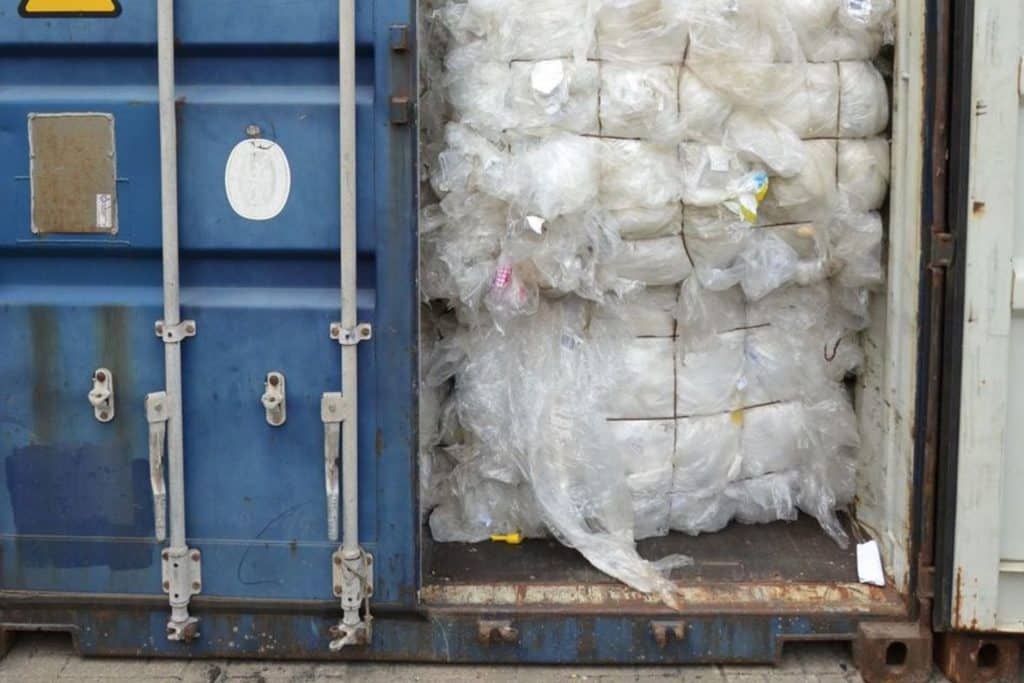
waste exports prosecution
One of the 22 containers of waste investigated (courtesy of the Environment Agency)

Other contaminants included numerous items of clothing, textiles and rags, unopened plastic bags, glass, wood, golf balls, toys, a used toilet brush and contaminated food and drink cartons.

Mr McCann told the court that the defendant was the sole director of Berry Polymer Limited, a company which was dissolved on 24 August 2021, at the time of the offending.

Wang had agreed to sell some 500 tonnes of plastic bottle waste to a broker at £270 per tonne. A purchase order confirmed the load site of the waste as “Berry Polymer Limited, 20 The Furlong Droitwich WR9 9AH.” Berry Polymer invoiced the broker £103,210.20 for 382.26 tonnes of “plastic bottles.”

The offence was discovered by Environment Agency officers who conducted initial inspections of some of the 22 containers at the ports of Southampton (17 containers) and Felixstowe (5) on 4 July 2019.

These inspections recorded significant evidence of contamination, flies and, in some containers, a rotting decomposing smell.  The containers were deemed unfit for export at that stage and prevented from onward shipment to Indonesia.

Five of the containers were transported to the Environment Agency’s inspection facility at Felixstowe for full examination, one of the bales examined was so bad that an officer was physically sick.  Ultimately all the containers were returned to the site in Droitwich for reprocessing.

When interviewed, Wang, who was abroad at the time, said the material supplied was not as described because his company’s usual bale inspection had either not happened or was sub-standard.

In sentencing, District Judge Strongman said this was a “blunder” by Wang, which had cost him his business and his reputation.

This prosecution sends out a strong message that we will investigate and where necessary prosecute anyone found to be involved in illegally exporting waste.

Waste crime can have a serious environmental impact and puts communities at risk. It undermines legitimate business and the investment and economic growth that goes with it.

We support legitimate businesses and are proactively supporting them by disrupting and stopping the illegal waste exports.

Sham Singh, senior investigating officer for the Environment Agency

In this case the defendant was charged with offences under the Transfrontier Shipment of Waste Regulations 2007 (TFS).  The export of waste collected from households to non-OECD (Organisation for Economic and Development) countries is prohibited by Article 36 of the Waste Shipment Regulations.  The offence of transporting waste to a non-OECD country in breach of the prohibition is created by Regulation 23 and the directors’ offence by regulation 55(1) of the TFS Regulations 2007. The offence is one of strict liability – strict liability offences are crimes which require no proof of intent. Strict liability offences are primarily regulatory offences aimed at businesses in relation to environment, health and safety.

A shipment of waste starts at the point of loading in the country of dispatch and continues until the waste has been recovered at the facility in the country of destination. This is why the export is not regarded as an attempt, despite the containers being prevented from leaving Felixstowe and Southampton.

For waste to be categorised as green list such as plastic waste, it must have been collected separately or been properly sorted.

Properly sorted means that the sorting is sufficient to remove contaminants to the point where any contamination that remains is so small as to be minimal and does not prevent the waste from becoming green list waste. If you require environmental advice or support for your business, please contact one of the Ashbrooke team.

TCM attendance changes

The Environment Agency has published the results of a consultation on TCM attendance changes.  The Environment Agency consulted with stakeholders to hear their views on proposed options and changes to the attendance requirements for technically competent managers (TCMs).

The consultation explained:

  • how the current technical competence attendance requirements work
  • options for proposed changes to the methods of calculating TCM attendance and other proposed changes to the attendance requirements
  • proposed implementation timescales

The responses to the TCM attendance changes consultation will help shape a second, more detailed consultation.  This will provide further details for option 1: attendance linked to charge bands, and other rules associated with the attendance requirements for technically competent managers.  The EA aim to publish the next consultation in summer 2023.

The EA received a broad range of views which will help develop guidance on the attendance requirements for technically competent managers.  The EA received 75 responses to the consultation:

  • 32 from site operators and companies with permits
  • 18 from trade associations and other organisations and groups
  • 12 from consultants
  • 5 from local authorities
  • 8 from individuals and members of the public

Those responding generally agreed that new guidance was needed to explain the attendance requirements for TCMs and provided views on the 3 options preferred for calculating the attendance requirements:

  • option 1: attendance linked to charge bands – 36%
  • option 2: standard baseline attendance for all waste facilities – 16%
  • option 3: tailored baseline attendance for waste operations and waste installations – 30.67%
  • no preference – 14.67%
  • Two respondents (2.67%) did not provide an answer to this question.

Many of those responding highlighted the potential for environmental benefits should TCM attendance increase at poor performing sites. However, the extent of this benefit would depend on the specific circumstances. Approximately 75% of those responding supported the adjustment of the attendance requirement based on operator performance, with those in deteriorating or poor compliance bands requiring increased TCM attendance.

TCM attendance changes
Changes proposed to TCM attendance requirements at waste sites

Some of those responding stated that applying attendance requirements for the Environmental Services Association (ESA)/Energy & Utility (EU) Skills technical competence scheme would undermine the purpose of this scheme, but there was general support for other proposals on the 48 hour attendance cap, 24 hour operations, multiple regulated facilities and mothballed sites.

For permit transfers, some respondents highlighted situations where transfers were ‘administrative’ and in those instances they did not support previously agreed TCM attendance requirements reverting back to those required by the guidance.

For closed landfills nearly 40% of respondents agreed with the proposals, whilst 50% did not have a view. The Environment Agency concluded that it anticipate the majority of the 50% who did not have a view do not operate activities involving closed landfills.

Most of those who responded did not have a view on the proposals for mobile plant attendance requirements. Around one third supported the proposals on mobile plant and less than 10% disagreed.

Nearly half of respondents supported a 12 month implementation period for the new guidance. Because, for example, this would give operators time to understand the new guidance and train or recruit additional TCMs if required.

The Agency received a broad range of views which will help develop the attendance requirements for TCMs guidance and it intends to launch the next consultation in summer 2023. It will include further details of the favoured option and other proposed changes to the attendance requirements.

Operators who apply for an environmental permit for a waste operation must be members of (and comply with) a government approved technical competency scheme. Most existing waste environmental permit holders must also comply with a government approved technical competency scheme through the conditions in their permits.

For operators that show competence through the scheme run by the Chartered Institution of Wastes Management and Waste Management Industry Training and Advisory Board, the Environment Agency requires that sites have nominated technically competent manager(s) on site for a specified amount of time each week – this is called the attendance requirement.

The Environment Agency used to calculate attendance requirements using the OPRA risk appraisal guidance. However, except for the sections relating to attendance levels for technically competent managers, this guidance has been withdrawn.

The Agency is now considering changes to the requirements for attendance by TCMs at environmental permit sites. If you require environmental advice or support for your business, please contact one of the Ashbrooke team.

Urgent need to work with nature

An Environment Agency report highlights an urgent need to work with nature and lays bare the scale of change needed to halt England’s biodiversity and climate crisis.

Published in July, the report sets out how significant changes will be needed to how land is used in England, with the need for significant landscape scale interventions and the use of nature-based solutions to help wildlife recover, and for humans to mitigate and adapt to the effects of climate change.

The ‘Working with Nature’ report compiled by Environment Agency scientists sets out the global challenges facing the basics for life on Earth – clean water, climate regulation and food. It describes the potential loss of complex natural ecosystems that provide such essentials as an existential risk to human survival.

Referencing Rachel Carson’s 1962 book Silent Spring, considered by many to be the most important piece of environmental writing of the 20th century, Environment Agency chief executive, Sir James Bevan, spoke about the ‘silent spring’ that awaits humanity unless action is taken by businesses, government and individuals to prevent further damage and rebuild the natural environment.  The report was unveiled at an event hosted by the Green Alliance, ahead of the COP15 Biodiversity Conference taking place later this year.  Internationally, the G7 leaders have committed to the global mission to halt and reverse biodiversity loss by 2030. The COP 15 meeting of the UN Convention on Biological Diversity (CBD) in 2022 will review the progress towards previously agreed Biodiversity targets.

“The biodiversity crisis joins the climate crisis as an existential risk to our survival, but as this report sets out the solution is not to retreat but to work together to build a nature-positive response.

Nature provides the basics for life – clean water, clean air and food. With major pressures on land use across England, nature-based solutions must be a major part in our response to protect these essentials whilst rebuilding our natural world.”

Sir James Bevan, Environment Agency Chief Executive
urgent need to work

England is one of the most nature-depleted countries in the world due to its long history of industrialisation and land use changes over millennia. There is an urgent need to work with nature as large areas of habitats have been lost with 99.7% of fens, 97% of species-rich grasslands, 80% of lowland heathlands, up to 70% of ancient woodlands and up to 85% of saltmarshes destroyed or degraded.

The impacts on species have also been severe, with a quarter of mammals in England and almost a fifth of UK plants threatened with extinction.

Nature in England has also been impacted by pressures on land use. The report sets out the impact of the last 50 years of agricultural production and points to the likelihood of a need of further intensification and increased yields from agricultural land. It also charts the impacts of urbanisation, forestry and the need for large areas of land for climate change mitigation.

To address the major declines in biodiversity that will only be accelerated by a changing climate, the report sets out a need for more land to be dedicated to nature conservation to act as refuges for nature and to mitigate against climate change – such as coastal wetlands to combat flood risks.  However, with such demand on land, it will need to provide multiple benefits to people and nature.

The Environment Agency has a leading role to play in restoring or recreating new wildlife-rich habitat in England. Recent projects include peat restoration at Great Fen, Cambridgeshire, which will save 325,000 tonnes of CO2 from being released each year while restoring habitats for threatened fenland species and protecting surrounding towns, villages and farmland from the risk of flooding after heavy rainfall.

The report identifies such nature-based solutions as a crucial tool in restoring nature and achieving multiple other benefits. By working with nature, including tree planting, peat restoration, species reintroductions and natural flood management, it suggests there are opportunities to restore biodiversity, whilst providing other benefits such as carbon sequestration, flood protection and clean and plentiful water.

The report also says action will also be required to address the levels of consumption in wealthy countries, which contribute to the loss of biodiversity, and that sustained effort will be required from many people and organisations at forums like the COP 15 meeting of the UN Convention on Biological Diversity to tackle the effects of global consumption, production and supply chains.
If you require advice on environmental issues, please contact one of the Ashbrooke team.