If you employ people, the Control of Noise at Work Regulations 2005 almost certainly apply to your business. What differs from one workplace to the next is whether noise reaches the levels that trigger specific duties: 80, 85 and 87 decibels.
Who the Noise at Work Regulations apply to
The Regulations apply wherever work exposes people to a risk to their hearing. That covers your employees and other workers affected by your work activities, in virtually every sector. There is no exemption for small businesses, so the size of your firm does not decide the question; the noise in your workplace does.
- Employers. If your employees are, or are likely to be, exposed to noise at or above the lower exposure action value, you have legal duties.
- The self-employed. They can be covered too, because the Regulations treat a self-employed person as both employer and employee. The scope was narrowed by a 2015 amendment, so check your own position.
- Music and entertainment. Pubs, bars, restaurants, nightclubs and venues with live music have been fully covered since 6 April 2008.
- Great Britain only. Northern Ireland has its own Control of Noise at Work Regulations (Northern Ireland) 2006, and the Republic of Ireland and the Isle of Man have separate rules.
What the Regulations do not cover: members of the public exposed to noise from their own non-work activities, or who choose to go to noisy places, and low-level noise that is a nuisance but poses no risk of hearing damage.
The noise levels that trigger action
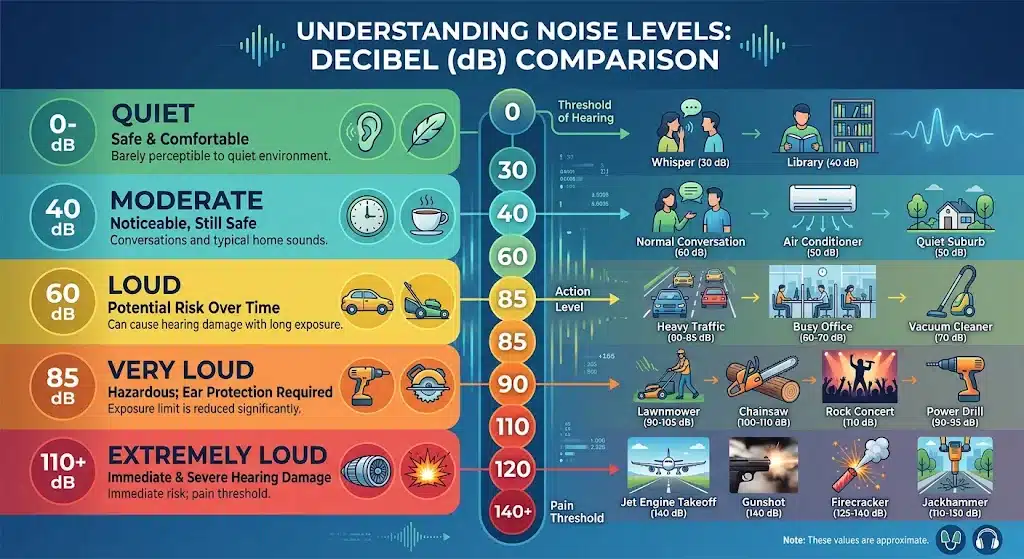
The Regulations set three tiers, measured as an average over a working day or week and as a peak. Reaching either figure in a tier is enough to trigger that tier.
| Tier | Daily or weekly exposure | Peak sound pressure |
|---|---|---|
| Lower exposure action value | 80 dB(A) | 135 dB(C) |
| Upper exposure action value | 85 dB(A) | 137 dB(C) |
| Exposure limit value | 87 dB(A) | 140 dB(C) |
Two details matter in practice. If a person’s exposure varies markedly from day to day, you can use their weekly exposure instead of the daily figure. And hearing protection is taken into account when applying the exposure limit values, but not when applying the action values, so wearing earmuffs does not take someone below an action value.
What you must do at each level
At or above the lower action values (80 dB(A) or 135 dB(C))
- Assess the risk to your employees’ hearing (regulation 5).
- Make hearing protectors available free of charge to anyone who asks for them (regulation 7).
- Give employees information, instruction and training on the risks and how to protect themselves.
At or above the upper action values (85 dB(A) or 137 dB(C))
- Put in place a programme of measures, other than hearing protectors, to reduce exposure as low as is reasonably practicable (regulation 6(2)).
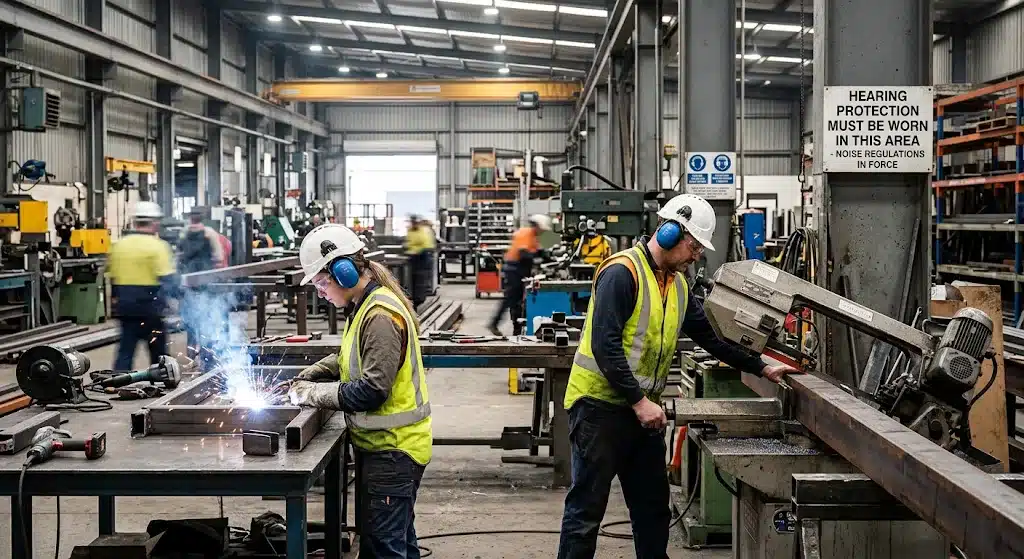
- Provide hearing protectors free of charge and make sure they are worn (regulation 7).
- Mark hearing protection zones with appropriate signs (regulation 7(3)).
The exposure limit values (87 dB(A) or 140 dB(C))
- These must not be exceeded, once the protection given by hearing protectors is taken into account (regulations 4 and 6(4)).
Where there is a risk to health at any level, you must also provide health surveillance, which in practice means regular hearing checks.
Workplaces where noise is most often a problem
Noise at or above 80 dB(A) is common in these settings, so they are the first places to assess:
- Manufacturing, engineering and metalworking
- Construction, demolition and groundworks
- Woodworking and joinery
- Agriculture and food processing
- Pubs, bars, nightclubs, restaurants and live music venues
- Warehouses and logistics sites with powered equipment
Offices are rarely affected, but a plant room, print room or nearby workshop can change that. If anyone in your business works near loud machinery, tools or amplified sound, assume you need to check.
FAQs
Do the Noise at Work Regulations apply to offices?
In principle they apply to all workplaces, but typical office noise is well below the 80 dB(A) lower action value, so the duties above are rarely triggered. Check any noisy equipment, plant rooms or workshop areas on the premises.
Do the Regulations apply to small businesses and sole traders?
Small businesses are covered in the same way as large ones if their employees are at risk. Self-employed people can also be covered, so check your own circumstances.
Do I need a noise risk assessment?
Yes, if your work is likely to expose any employee to noise at or above the lower exposure action value. The HSE website offers noise exposure calculators to help you estimate exposure.
Do the Regulations protect customers and visitors?
Not from noise they choose to be exposed to, such as at a concert or in a noisy bar. Your own staff working in that venue are covered.
Do you know what laws apply to your business?
We can provide bespoke legal registers detailing every piece of health and safety and environmental legislation that applies to your business. Contact one of our team to see how we can help your business be compliant.
