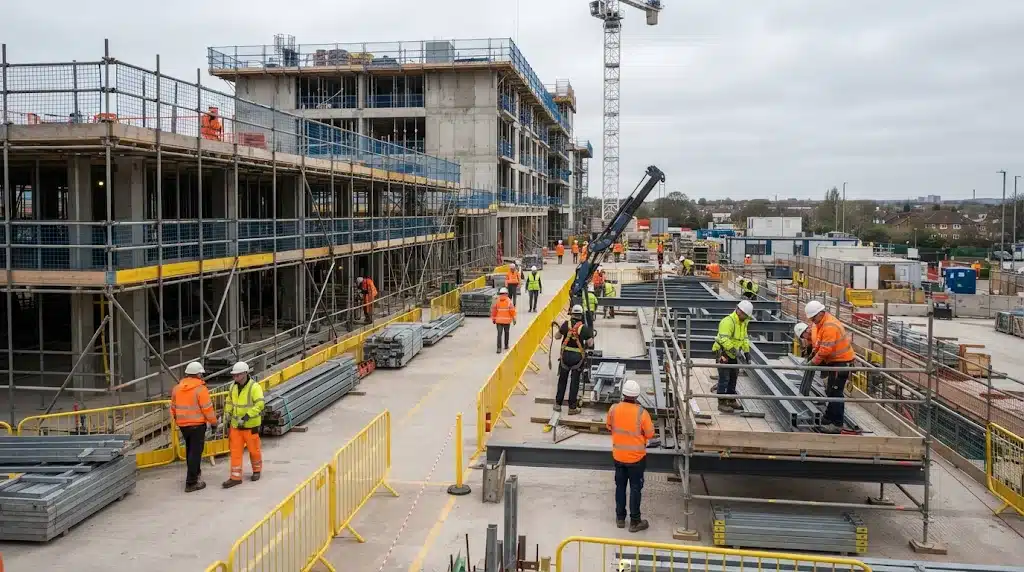
Operating safely in the UK construction sector is both a moral obligation and a strict statutory requirement. Because construction sites present dynamic, high-hazard environments—ranging from working at height and heavy plant operations to hazardous dust exposure—the sector is governed by a robust legal framework enforced by the Health and Safety Executive (HSE).
Failing to comply with UK construction health and safety law exposes businesses and directors to severe consequences, including improvement and prohibition notices, unlimited fines, project delays, reputational damage, and criminal prosecution. Understanding the core legislation and how duties are distributed across project teams is essential for maintaining compliance.
The Foundation: The Health and Safety at Work etc. Act 1974
The cornerstone of all UK workplace safety legislation is the Health and Safety at Work etc. Act 1974 (HSWA). It places a overarching legal duty on employers to ensure, so far as is reasonably practicable, the health, safety, and welfare at work of all their employees.
In a construction context, this general duty extends to:
- Protecting non-employees: Safeguarding subcontractors, site visitors, delivery drivers, and members of the public who may be affected by site operations.
- Safe systems of work: Establishing clear operational procedures, permit-to-work systems, and risk controls.
- Safe plant and equipment: Ensuring machinery, scaffolding, and tools are properly maintained and inspected.
- Information, instruction, training, and supervision: Delivering thorough site inductions, toolbox talks, and competent oversight.
- Welfare facilities: Providing clean, accessible toilets, washing facilities, drinking water, and rest areas from day one of the project.
Management of Health and Safety at Work Regulations 1999
Supporting the 1974 Act, the Management of Health and Safety at Work Regulations 1999 require employers and self-employed contractors to take a proactive, structured approach to risk management. Key obligations include:
- Carrying out suitable and sufficient risk assessments before work begins and reviewing them as site conditions change.
- Appointing one or more competent persons with the necessary training, experience, and knowledge to assist with health and safety compliance.
- Establishing formal emergency procedures for serious and imminent danger, such as fire or structural collapse.
- Cooperating and coordinating safety arrangements when multiple employers share a workplace.
The Construction (Design and Management) Regulations 2015 (CDM 2015)
The Construction (Design and Management) Regulations 2015 are the primary regulations governing how health and safety is planned, managed, and coordinated throughout the entire lifecycle of a UK construction project—from initial concept through to completion and future maintenance.
CDM 2015 applies to all construction projects in Great Britain, regardless of size, duration, or whether the client is commercial or domestic. (Northern Ireland operates under equivalent legislation: the Construction (Design and Management) Regulations (Northern Ireland) 2016.)
Key Dutyholders Under CDM 2015
| Dutyholder | Core Legal Responsibilities |
| Commercial Client | Make suitable arrangements for managing the project; appoint a Principal Designer and Principal Contractor in writing (where more than one contractor is involved); provide pre-construction information; ensure welfare facilities are provided. |
| Domestic Client | Duties automatically transfer to the contractor (single-contractor project) or the Principal Contractor (multi-contractor project), unless agreed otherwise in writing with the Principal Designer. |
| Principal Designer | Plan, manage, monitor, and coordinate health and safety during the pre-construction phase. Identify, eliminate, or control foreseeable design risks and prepare the Health and Safety File. |
| Principal Contractor | Plan, manage, monitor, and coordinate health and safety during the construction phase. Draw up the Construction Phase Plan, organise site inductions, secure the site perimeter, and coordinate subcontractors. |
| Designers | Eliminate, reduce, or control foreseeable health and safety risks through design decisions and provide clear information about remaining risks. |
| Contractors | Plan, manage, and monitor the construction work under their own control; comply with directions from the Principal Contractor; ensure workers have the right skills, knowledge, training, and experience. |
| Workers | Cooperate with dutyholders, follow site rules and safe systems of work, use provided equipment properly, and report any unsafe conditions immediately. |
Essential CDM Documentation and Notifications
- Pre-Construction Information (PCI): Supplied by the client to designers and contractors to highlight existing site hazards (such as asbestos surveys or underground services).
- Construction Phase Plan (CPP): Required for every construction project before work starts on site, setting out the site rules, risk controls, and management arrangements.
- Health and Safety File: Required on projects involving more than one contractor; handed over to the client at completion to guide safe future maintenance, refurbishment, or demolition.
- F10 Notification to the HSE: Mandatory when construction work is scheduled to last longer than 30 working days and have more than 20 workers working simultaneously at any point, or when the project exceeds 500 person-days of construction work.
Task-Specific Health and Safety Regulations
Beyond overarching management duties, construction businesses must comply with specific statutory regulations targeting high-risk site activities:
- Work at Height Regulations 2005: Falls from height remain the single largest cause of fatal injuries in UK construction. Dutyholders must avoid working at height where possible, use collective fall prevention (such as guardrails and scaffolding) before personal fall arrest equipment, and ensure all work at height is properly planned, supervised, and inspected.
- Control of Substances Hazardous to Health Regulations 2002 (COSHH): Requires employers to assess and control exposure to hazardous substances. In construction, this heavily governs respirable crystalline silica (RCS) dust, wood dust, cement, solvents, and welding fumes.
- Control of Asbestos Regulations 2012: Mandatory when working on buildings constructed before the year 2000. Requires refurbishment or demolition asbestos surveys prior to intrusive work, licensed contractors for high-risk removal, and strict waste disposal controls.
- Provision and Use of Work Equipment Regulations 1998 (PUWER): Ensures all work equipment and machinery is suitable for its intended use, maintained in safe working order, inspected regularly, and operated only by trained personnel.
- Lifting Operations and Lifting Equipment Regulations 1998 (LOLER): Requires all lifting operations involving cranes, hoists, telehandlers, and slings to be properly planned by a competent person, appropriately supervised, and subject to periodic thorough examinations.
- Reporting of Injuries, Diseases and Dangerous Occurrences Regulations 2013 (RIDDOR): Obliges employers and those in control of premises to report work-related deaths, specified major injuries, over-seven-day incapacitation injuries, occupational diseases, and dangerous occurrences (such as structural collapses or crane failures) to the HSE.
- The Building Safety Act 2022: Introduces stricter regulatory oversight, gateway checkpoints, and golden-thread information requirements for the design and construction of higher-risk buildings (such as high-rise residential buildings).
Practical Steps to Maintain Compliance
- Embed safety at the design stage: Engage Principal Designers early so hazards are designed out before plant arrives on site.
- Keep documentation live and site-specific: Generic Risk Assessments and Method Statements (RAMS) do not satisfy HSE inspectors. Tailor documents to the exact site layout, weather conditions, and sequencing.
- Verify competence across the supply chain: Audit subcontractors before appointment to verify training records, CSCS cards, insurance, and safety track records.
- Prioritise health risks alongside safety hazards: Occupational lung disease and musculoskeletal disorders cause far more long-term harm than acute accidents. Enforce on-tool dust extraction, local exhaust ventilation, and health surveillance.
- Conduct regular site inspections: Carry out documented weekly inspections of scaffolding, excavations, traffic segregation, and welfare facilities, closing out corrective actions promptly.
Partnering with a Health and Safety Consultant
Navigating overlapping statutory duties across multi-contractor sites requires specialist expertise. Whether you are a commercial client seeking assistance with CDM compliance, a principal contractor developing robust Construction Phase Plans, or a subcontractor looking to strengthen your RAMS and SSIP accreditation readiness, professional consultancy support helps protect your workforce, keep projects on schedule, and demonstrate clear legal compliance.
Ashbrooke Management Consultants can provide bespoke legal registers detailing all health and safety legislation applicable to your business and sites. For further information please contact one of our team.
