If you are working towards ISO 14001 certification, or maintaining it, the legal register is one of the areas auditors return to again and again. As with its ISO 45001 counterpart, it looks straightforward on paper — a list of environmental laws that apply to your business — but in practice it is one of the most common sources of non-conformities.
This article follows on from our piece on the ISO 45001 legal register, and covers the environmental equivalent: what a compliant ISO 14001 legal register needs to contain, why it matters, and how to keep it audit-ready.
What Is a Legal Register Under ISO 14001?
A legal register for ISO 14001 (referred to in the standard as “compliance obligations”) is a structured record of all the environmental laws, regulations, permits, consents, and other obligations that apply to your organisation’s activities, products, and services.
Clause 6.1.3 of ISO 14001:2026 requires organisations to determine and have access to up-to-date compliance obligations related to its environmental aspects, to determine how these apply to the organisation, and to keep this information current. The register is how you evidence that this has been done.
It is worth noting that ISO 14001 deliberately moved away from the term “legal register” in favour of “compliance obligations” to reflect that the scope is broader than statute law — but in practice, most organisations (and most auditors) still refer to it as the legal register, and we will use both terms here.
Why It Matters More Than It Looks
Just as with an OH&S legal register, this document is not a compliance checkbox — it is the foundation your environmental management system (EMS) is built on. It drives your aspects and impacts assessment, your operational controls, your monitoring and measurement programme, and your internal audit criteria. If the register is wrong or incomplete, everything built on top of it is at risk too.
Auditors will typically test the register in two directions:
Top-down — picking an environmental aspect (e.g. a waste stream, an emission point, a chemical store) and checking the relevant legislation is listed.
Bottom-up — picking an entry in the register and asking how it is being met in practice, such as through a permit condition or monitoring record.
If either direction breaks down, it is usually flagged as a non-conformity.
Core Elements Every Entry Should Include
While the exact format can vary, a robust legal register entry should contain the following information for each requirement:
Legislation or requirement title — the specific act, regulation, permit, licence, or other obligation (e.g. environmental permit condition, corporate group standard, client contractual clause).
Reference number or citation — the official identifier so it can be traced back to source.
Jurisdiction — which country, state, or region it applies to, especially important for multi-site organisations with different permit regimes.
Summary of the requirement — a plain-language description of what the law or permit condition actually requires, avoiding a copy-paste of dense legal text. This is often where expert consultants can be beneficial in interpreting the requirement for your business operations.
Applicability — why and how this requirement applies to your specific sites, processes, or environmental aspects. Generic entries (“Environmental Protection Act applies to all businesses”) are a common audit finding.
Compliance status — a clear statement of whether you currently comply, partially comply, or are working towards compliance. Particularly useful when first implementing ISO 14001.
Evidence of compliance — links or references to the specific permits, monitoring data, procedures, or records that demonstrate compliance.
Responsible person or role — who owns the register and is accountable for maintaining compliance.
Review date and frequency — when it was last checked and when it is next due for review.
Source of update information — how you monitor for changes (e.g. legislation update service, environmental regulator bulletin, trade body alert).
Date of last legislative change — useful for showing the register reflects the current version of the law or permit, not an outdated one.
Beyond Statutory Law: “Other Requirements”
Like ISO 45001, ISO 14001 explicitly extends beyond legislation to other compliance obligations the organisation has to, or chooses to, meet. These are easy to miss but often specifically probed by auditors. In an environmental context, they may include:
Environmental permits, licences, and consents (waste, water discharge, emissions to air)
If your register only lists statutory legislation and ignores these, it will not fully meet the clause requirement.
Your ISO 14001 legal register must include obligations as well as legislation
How to Structure the Register
There is no single structure every register must follow, and it is often shaped by the size, sector, and complexity of the organisation. Most organisations use a spreadsheet, a document, or a dedicated compliance software tool. Common groupings for an ISO 14001 register include:
Structuring it this way makes the register easier to cross-reference against your aspects and impacts register and operational controls, and much faster to navigate during an audit.
Keeping It Live: Review and Monitoring
A legal register is only useful if it stays current. ISO 14001 requires that this information be kept up to date, so your process needs to show:
A defined review frequency (many organisations review quarterly, with a full review annually)
A named responsible person for monitoring legislative and permit changes — this can be an internal representative or an external consultant
A method for capturing changes (legal update subscription services are common, as manually tracking regulator publications is unreliable)
A record of how changes were assessed and, where relevant, action taken (updated aspects and impacts assessments, new controls, revised monitoring)
Common Mistakes to Avoid
Treating it as a one-off exercise. Registers built once for certification and never revisited are one of the most frequent non-conformities.
Copying generic templates without tailoring. A register that does not reflect your actual sites, processes, and environmental aspects will not withstand scrutiny.
No link to evidence. Listing a requirement without showing how it is actually met leaves a gap between the register and reality.
Missing permit conditions. Focusing only on primary legislation and overlooking the specific conditions attached to site permits and licences.
No ownership. Without a named responsible person, updates tend to fall through the cracks.
Do I Need a Legal Register for ISO 14001 Certification?
Yes. A legal register (compliance obligations register) is a mandatory requirement of Clause 6.1.3 and is one of the first documents an auditor will ask to see, both at initial certification and at every surveillance audit. Without one, an organisation cannot demonstrate it has identified and is managing its environmental compliance obligations, which is a core requirement of the standard.
Final Thoughts
A well-built legal register does more than satisfy Clause 6.1.3 — it becomes a working tool that keeps your entire environmental management system grounded in what the law, your permits, and your other obligations actually require. Getting the structure right from the start, and building in a genuine review cycle, is what separates a register that passes audit from one that merely exists on paper.
If you are managing both standards together, it is worth reading this alongside our companion article on the ISO 45001 legal register — many organisations choose to maintain a single combined register covering both health and safety and environmental obligations, provided it clearly distinguishes between the two.
If you are working towards ISO 45001 certification, or maintaining it, one of the most common sticking points during audits is the legal register. It sounds like a simple document — a list of laws that apply to your business — but auditors consistently find registers that are either incomplete, out of date, or too vague to demonstrate real compliance.
This article breaks down exactly what a compliant legal register needs to contain, why it matters, and how to keep it audit-ready.
What Is a Legal Register?
A legal register (sometimes called a “legal and other requirements register”) is a structured record of all the health and safety laws, regulations, codes of practice, and other obligations that apply to your organisation’s activities, products, and services.
Under ISO 45001, Clause 6.1.3 requires organisations to determine and have access to up-to-date legal requirements and other requirements relevant to their occupational health and safety management system (OH&S MS), and to keep this information current. The register is how you evidence that you have done this.
Is your legal register up to date?
Why It Matters More Than It Looks
A legal register is not just a compliance checkbox. It is the foundation your OH&S management system is built on — it drives your risk assessments, your operational controls, your training needs, and your internal audit criteria. If the register is wrong or incomplete, everything built on top of it is at risk too.
Auditors will typically test the register in two directions:
Top-down — picking an activity or hazard on site and checking the relevant legislation is listed.
Bottom-up — picking an entry in the register and asking how it is being met in practice.
If either direction breaks down, it is usually flagged as a non-conformity.
Core Elements Every Entry Should Include
While the exact format can vary, a robust legal register entry should contain the following information for each requirement:
Legislation or requirement title — the specific act, regulation, code of practice, standard, or other obligation (e.g. industry code, insurer requirement, client contractual clause).
Reference number or citation — the official identifier so it can be traced back to source.
Jurisdiction — which country, state, or region it applies to, especially important for multi-site organisations.
Summary of the requirement — a plain-language description of what the law actually requires, avoiding a copy-paste of dense legal text. This is often where expert consultants can be beneficial in interpreting the law to your business operations.
Applicability — why and how this requirement applies to your specific operations, sites, or activities. Generic entries (“Health and Safety at Work Act applies to all businesses”) are a common audit finding.
Compliance status — a clear statement of whether you currently comply, partially comply, or are working towards compliance. This is particularly useful when first implementing ISO 45001.
Evidence of compliance — links or references to the specific procedures, records, permits, certificates, or controls that demonstrate compliance.
Responsible person or role — who owns the register and is accountable for maintaining compliance.
Review date and frequency — when it was last checked and when it is next due for review.
Source of update information — how you monitor for changes (e.g. legislation update service, trade body bulletin, government gazette, etc.).
Date of last legislative change — useful for showing the register reflects the current version of the law, not an outdated one.
Beyond Statutory Law: “Other Requirements”
ISO 45001 explicitly extends beyond legislation to “other requirements.” These are easy to miss but often specifically probed by auditors. They may include:
Corporate group standards (for multi-site or multinational organisations)
Voluntary agreements or membership scheme conditions
Permits, licences, and consents tied to specific sites or activities
If your register only lists statutory legislation and ignores these, it will not fully meet the clause requirement.
How to Structure the Register
There is no single structure that every register must follow, and it is often determined by the type, size or nature of the organisation itself. Most organisations use a spreadsheet, text document or a dedicated compliance software tool. Common groupings include:
Structuring it makes the register easier to cross-reference against your risk assessments and operational controls, procedures and much faster to navigate during an audit.
Keeping It Live: Review and Monitoring
A legal register is only useful if it stays current. ISO 45001 requires that this information be kept up to date, so your process needs to show:
A defined review frequency (many organisations review quarterly, with a full review annually)
A named responsible person for monitoring legislative changes, this can be a representative in the organisation but could also be an external consultant
A method for capturing changes (legal update subscription services are common, as manually tracking government publications is unreliable)
A record of how changes were assessed and, where relevant, actioned (updated risk assessments, new controls, revised training)
Common Mistakes to Avoid
Treating it as a one-off exercise. Registers built once for certification and never revisited are one of the most frequent non-conformities.
Copying generic templates without tailoring. A register that does not reflect your actual sites, activities, and hazards will not withstand scrutiny.
No link to evidence. Listing a requirement without showing how it is actually met leaves a gap between the register and reality.
Missing “other requirements.” Focusing only on statute law and ignoring client, insurer, or industry obligations.
No ownership. Without a named responsible person, updates tend to fall through the cracks.
Final Thoughts
A well-built legal register does more than satisfy Clause 6.1.3 — it becomes a working tool that keeps your entire OH&S management system grounded in what the law and your other obligations actually require. Getting the structure right from the start, and building in a genuine review cycle, is what separates a register that passes audit from one that merely exists on paper.
If you have been told you need a “legal register” and separately advised to commission a “compliance audit,” you could be forgiven for wondering whether these are two names for the same thing. They are not — and understanding the difference matters, because most organisations that fall foul of a health and safety enforcement notice have one of these two documents in place but not the other.
This article explains what each one actually does, how they work together, and which one your organisation needs first.
The short answer
A health and safety legal register identifies which legal requirements apply to your organisation. A compliance audit (or compliance evaluation) tells you whether you are actually meeting them.
One is a map. The other is a health check against that map. You need both, but they answer different questions, and confusing them is one of the most common gaps we find when we review a client’s health and safety management system.
What is a legal register?
A legal register is a structured record of the health and safety legislation, regulations, approved codes of practice, and other legal requirements that apply to your organisation’s specific activities, sites, and operations.
A good legal register will typically:
List each applicable piece of legislation (for example, the Management of Health and Safety at Work Regulations, COSHH, the Work at Height Regulations, or sector-specific rules)
Identify which parts of your business or which activities the requirement applies to
Identify the controls in place to meet the legal requirements
Be reviewed and updated as legislation changes or your operations evolve
Crucially, a legal register is a document of applicability. It answers the question: “What law applies to us, and what does it say we must do?” It does not, by itself, tell you whether you are doing it.
Site visits and observation of actual working practices
Review of documentation, records, and evidence (permits, training records, inspection logs, risk assessments)
Interviews with staff, supervisors, and duty holders
Gap analysis against each legal requirement
A findings report ranking non-conformities by risk and urgency
Recommendations and an action plan to close the gaps
Where the legal register is a snapshot of obligations, the compliance audit is a live assessment of performance. It is the difference between having a checklist and actually checking the boxes — and finding out, in evidence-based detail, which ones you cannot honestly tick yet.
Legal Register
Records applicable legislation for the organisation
Sets the bench mark for compliance
Must be regularly reviewed & updated
Identifies controls in place
Bespoke to the organisation
Can be one jurisdiction or more
Compliance Audit
Identifies if you actually meet the legal requirements
Assesses at a specific point in time
Site visits, observations & staff interviews
Review of documentation, records, etc.
Gap analysis
Recommendations & action plan
Why the difference matters
We regularly see organisations that have invested in one of these tools and assumed it covers the other. Both mistakes carry real risk.
Legal register without an audit: You know what the law requires, but nobody has verified whether it’s happening on the ground. This is common where a legal register was purchased as a subscription product or generated once and filed away. It creates a false sense of security — the document exists, so the box feels ticked, but there is no evidence of actual conformance if an inspector, insurer, or regulator asks for it.
Audit without a legal register: You get a snapshot of current practice, but without a clear, maintained baseline of what should apply, the audit scope is often built from generic checklists or the auditor’s working knowledge rather than your organisation’s specific legal exposure. Gaps in obligations you did not know applied to you can be missed entirely.
Used together, the legal register defines the scope of what to check, and the audit provides the evidence of whether you are meeting it. This combination is also what regulators, insurers, and courts expect to see when assessing whether an organisation exercised due diligence — a legal register with no corroborating evidence of compliance checking is a weak defence in an enforcement case or civil claim.
How they fit into a health and safety management system
Think of it as a three-stage cycle:
Identify — the legal register captures every applicable requirement
Evaluate — the compliance audit tests current practice against each requirement
Act — a corrective action plan closes the gaps the audit identifies, and the cycle repeats on a review schedule
This mirrors the “Plan-Do-Check-Act” approach that underpins recognised health and safety management standards such as ISO 45001 and HSG65. A legal register alone only covers “Plan.” Without the “Check” stage — the audit — you have no mechanism to confirm the plan is working.
Which do you need first?
If your organisation does not currently have a legal register, that is the logical starting point — you cannot meaningfully audit compliance against requirements you have not formally identified.
If you already have a legal register but it has not been tested against actual site practice in the last 12 months, a compliance audit should be your next step. An out-of-date or unverified register can quietly become a liability rather than an asset.
Get a clear picture of your legal exposure and compliance status
Many organisations discover during an audit that gaps have existed for months or years without anyone noticing — often because the legal register and the audit process were never properly connected.
If you are not sure whether your current legal register is complete, whether your last audit was thorough enough, or where to start with either, we can help. We carry out legal register development, gap analysis, and full compliance audits tailored to your sector and operations, with a clear, prioritised action plan at the end of it — not just a list of problems. We have experience in a variety of sectors to meet your needs.
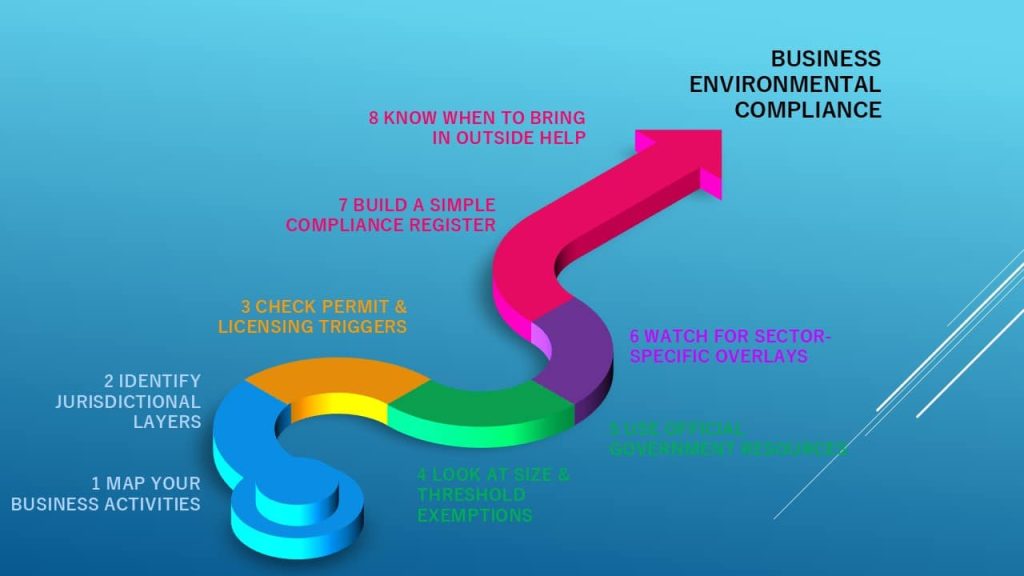
Environmental compliance can feel like an impossible maze. Regulations pile up at the local, national, and sometimes international level. They also shift depending on your industry, your size, your location, and even the specific materials you handle. Many business owners freeze at this point, assuming they need a law degree just to figure out where to start.
The good news is that you do not. You do not need to become an environmental lawyer, but you do need to know which requirements apply to your operations. This article walks through a practical process for narrowing down the environmental legislation for businesses that actually matters to your business, so you can focus your time and resources on real compliance instead of guesswork.
Why This Matters Before You Even Start
Non-compliance with environmental law is not a minor administrative slip. Depending on jurisdiction, penalties can include significant fines, operational shutdowns, personal liability for directors, and reputational damage that outlasts any fine. On the other hand, over-compliance — spending resources chasing rules that do not apply to you — wastes money and attention that could go toward growth. Getting the scope right is the foundation of an efficient compliance program.
Step 1: Map Your Business Activities, Not Just Your Industry
Legislation is often triggered by specific activities rather than by industry labels. A “manufacturing” business might trigger air emissions rules because of a paint booth, water discharge rules because of a wash-down process, and hazardous waste rules because of solvent disposal — three separate regulatory regimes from three separate activities.
Start by listing:
What raw materials, chemicals, or substances you use, store, or produce
What waste streams your operations generate (solid, liquid, air, hazardous)
Whether you discharge anything to water, air, or land
Whether you import, export, transport, or store regulated goods
The physical footprint of your operations (land use, proximity to protected areas or waterways)
This activity-based map is usually far more useful than starting from your business’s official industry classification.
Step 2: Identify Your Jurisdictional Layers
Environmental law is rarely a single rule book. Most businesses need to check multiple layers:
Local rules — SSSI designations, noise, local waste collection and disposal by-laws
National legislation — overarching frameworks such as clean air, clean water, or waste management Acts or Statutory Instruments
International or trade-related obligations — relevant if you import/export goods or waste, use certain packaging, or operate across borders
A rule of thumb: start at the national level to understand the broad framework, then narrow down to local rules, which often add stricter or more specific obligations on top.
Step 3: Check for Permits and Licensing Triggers
Many environmental obligations are tied to permits rather than blanket rules. Common triggers include:
Operating certain types of equipment (boilers, generators, refrigeration systems with regulated refrigerants)
Extracting or using groundwater
If any of these apply, there is likely a permitting authority you need to register with, and permits often come bundled with monitoring, record keeping, and reporting duties.
Step 4: Look at Size and Threshold Exemptions
Many environmental regulations include size-based thresholds — for example, exemptions or reduced obligations for small quantity generators of waste, or simplified reporting for smaller emitters. Do not assume a regulation applies in full just because it mentions your industry; check the thresholds carefully, since they can significantly change your compliance burden.
Step 5: Use Official Government Resources
Regulatory agencies typically publish guidance documents, compliance checklists, and industry-specific fact sheets designed for non-specialists. These are usually more current and more directly applicable than general online summaries. Useful sources include:
National environmental protection agency websites such as the Environment Agency in England and Wales, SEPA in Scotland
State or provincial environment department portals such as DEFRA and DAERA
Local council or municipal planning and environmental health offices
Industry association compliance guides
Step 6: Watch for Sector-Specific Overlays
Certain sectors carry additional layers of regulation on top of general environmental law — food and beverage, construction, agriculture, manufacturing, healthcare, and mining are common examples. If you operate in one of these sectors, check for sector-specific statutes or codes of practice in addition to general environmental legislation.
Step 7: Build a Simple Compliance Register
Once you have identified applicable legislation, do not leave it in your head or in scattered notes. Build a basic register or registers that track:
The specific regulation or permit requirement
The regulating authority
Renewal or reporting deadlines
The internal person responsible / procedure applicable
Evidence or records required to demonstrate compliance
This turns a one-time research exercise into an ongoing management tool.
Step 8: Know When to Bring in Outside Help
Self-assessment gets you most of the way, but some situations warrant professional input — complex permitting processes, contaminated land issues, mergers or acquisitions involving environmental liabilities, or any situation where the penalties for getting it wrong are severe.
Environmental consultants and lawyers are most valuable when used strategically and will provide real value to the process.
The Benefits of Bringing in an External Consultant
Even with a solid self-assessment process in place, an external environmental consultant can add real value. Consultants work across many businesses and jurisdictions, so they tend to spot applicable legislation and emerging regulatory changes faster than an internal team researching the topic for the first time.
Consultants can also benchmark your operations against industry-specific obligations you might not think to check, verify that thresholds and exemptions have been applied correctly, and flag overlapping requirements between local and national regulators before they become a problem.
Beyond the initial identification exercise, a consultant can help translate legislation into practical action — building or auditing your compliance register, preparing permit applications, and liaising directly with regulators on technical points. For businesses expanding into new activities, new sites, or new jurisdictions, this outside expertise often pays for itself by preventing costly missteps, reducing the time your team spends on unfamiliar regulatory research, and giving management confidence that nothing material has been missed.
Final Thoughts
Identifying which environmental legislation applies to your business is less about legal expertise and more about a structured process. Understand your activities, map the jurisdictional layers, check permitting triggers and thresholds, use official guidance, and keep a living record of what applies. Approached this way, environmental compliance becomes a manageable, ongoing part of running your business rather than an intimidating unknown.
If you would like to see how we can help you identify which environmental legislation applies to your business, please contact one of our team.
Why not download our health and safety and environmental legal register checklist for UK operations.
UK health and safety law is not a single rule book that every business follows in the same way. Instead, it’s a layered system: the Health and Safety at Work etc. Act 1974 (HSWA) sets out broad duties that apply to almost every employer, while dozens of more specific regulations — made under that Act — only apply depending on what your business actually does. Many owners and managers assume that because they have done a general risk assessment, they are covered. In practice, working out your full legal obligations means looking closely at your activities, equipment, premises and workforce, not just your industry label.
This article walks through the main factors that determine which UK regulations apply to your business, so you can build an accurate picture of your legal duties rather than relying on guesswork.
Start with the general duties under HSWA 1974
The Health and Safety at Work etc. Act 1974 is the foundation of UK health and safety law. It places a general duty on employers to ensure, so far as is reasonably practicable, the health, safety and welfare of their employees, and to protect others — such as contractors, visitors and the public — who may be affected by their work. The Act also places duties on the self-employed and on those in control of premises.
HSWA rarely tells you exactly what to do in a given situation. Instead, it is supported by a wide range of secondary legislation — mostly Statutory Instruments enforced by the Health and Safety Executive (HSE) or your local authority — that add specific, practical requirements. Identifying which of these regulations apply to you depends on several interacting factors.
Factor 1: The nature of your work activities
The single biggest driver of applicability is what your business actually does day to day. UK regulations are often built around specific hazards or types of work, meaning two businesses in the same broad sector can have quite different legal obligations depending on the tasks involved. Common examples include:
Each of these activities brings its own dedicated regulations into scope, separate from the general HSWA duties.
Factor 2: The substances and materials you work with
If your business handles chemicals, dust, fumes, biological agents or other hazardous substances, the Control of Substances Hazardous to Health Regulations 2002 (COSHH) is likely to apply — regardless of your sector. This is not limited to obviously “industrial” settings; hairdressers, cleaners, print shops, laboratories and even offices using certain equipment can fall within scope. Applicability depends on the substance itself, how it is used and stored, and the level of exposure risk — not on your business type. Where lead or asbestos are involved specifically, separate dedicated regulations apply on top of COSHH.
The type of premises you occupy, and how they are used, brings separate legislation into play:
Fire safety is governed by the Regulatory Reform (Fire Safety) Order 2005, which applies to almost all non-domestic premises and places duties on the “responsible person”
A business operating from a warehouse, a shop, a construction site or a shared office block may each face different obligations relating to the physical environment, even where their core work activity is otherwise similar.
Factor 5: The size and structure of your business
Some duties scale with headcount. Under the Management of Health and Safety at Work Regulations 1999, employers with five or more employees must record significant findings of their risk assessments in writing and have a written health and safety policy. Businesses below that threshold still carry the same underlying legal duty to manage risk — they simply have lighter documentary requirements. Separately, if you employ anyone, you are generally required to hold Employers’ Liability Insurance under the Employers’ Liability (Compulsory Insurance) Act 1969, with limited exemptions.
Factor 6: Who is affected by your work
UK legislation does not only protect your direct employees. HSWA and related regulations also require you to consider contractors, visitors, and members of the public affected by your activities. This is particularly relevant if you:
Invite the public onto your premises (retail, hospitality, leisure)
Send staff to work on other organisations’ sites
Manage shared workspaces where multiple employers’ activities interact
Certain industries carry their own dedicated regulatory frameworks layered on top of general health and safety law, including:
Construction — CDM Regulations 2015
Agriculture — regulations covering machinery guarding, livestock handling and pesticides
Food businesses — food hygiene regulations sit alongside (not instead of) health and safety law
Healthcare — additional infection control and clinical waste regulations
Transport and logistics — drivers’ hours rules and vehicle-specific regulations
These sector-specific rules typically sit alongside general legislation like HSWA and the Management Regulations, rather than replacing them.
Factor 8: Enforcement authority and regional variation
In Great Britain, enforcement is split between the HSE (typically for higher-risk sectors like construction, manufacturing and agriculture) and local authorities (typically for offices, retail and hospitality) — it is worth knowing which applies to your business, as this affects who you report incidents to and who may inspect your premises. Note also that Northern Ireland has its own health and safety legislative framework, enforced by the Health and Safety Executive for Northern Ireland (HSENI), which mirrors but is legally separate from GB law. Businesses operating across the UK should check they are not assuming GB regulations automatically extend to Northern Ireland.
Putting it together: a practical approach
Rather than trying to memorise every regulation that might apply, it is more effective to map your business against these factors systematically:
List your work activities — every task carried out by staff, not just the “main” job.
List the substances, equipment and materials involved in each activity.
Map your premises types and how each is used, including shared or third-party sites.
Check your headcount against the five-employee threshold for written documentation.
Identify who else is affected — contractors, visitors, the public.
Check for sector-specific regimes relevant to your industry.
Confirm your enforcing authority (HSE or local authority) and whether Northern Ireland rules apply.
Working through this list will usually surface a shortlist of applicable regulations that goes well beyond HSWA’s general duties alone. Because legislation is periodically updated, it is worth revisiting this exercise whenever your activities, premises or workforce change significantly — and consulting a qualified health and safety adviser or solicitor if you are uncertain how a specific regulation applies to your circumstances.
Getting this right is not just about compliance for its own sake. Understanding exactly which legislation applies to your business is the foundation for building risk assessments, policies and training that address the hazards your people actually face — rather than a generic checklist that misses what matters most.
Determining which legislation is applicable in your business can be complicated and time consuming, although the Health and Safety Executive acknowledges that businesses need to identify the laws relevant to their particular industry and activities.
We identify the health & safety legislation relevant to your specific activities and produce a bespoke legislation register. We can also provide a regular update service so that you can focus on running your business. If you would like a quotation or more information about the services we offer, please contact us.
Would you like a free copy of our health and safety and environmental legal register checklist?
An environmental permit management system provides a structured framework of procedures to minimise pollution risks from permitted activities.
For regulated waste management, mining, or installation facilities, maintaining a written management system is a regulatory requirement.
This document outlines statutory compliance frameworks, risk assessments, site planning, and operational records to satisfy Environment Agency expectations.
Regulatory context and application requirements
1. Regulatory Context and Application Requirements – Environmental permit management system
The scope and submission requirements depend on the nature of the application.
Moreover, the complexity of site operations determines the system needs, including • Environmental permit management system.
Additionally, Standard Rules permits the – Environmental permit management system.
Risk Identification: Specific operational risks are pre-determined within generic risk assessments.
Submission Protocol: You do not need to submit the system documentation during the application phase.
Deployment Deadline: The complete management system must be fully operational prior to commencing site activities.
Regulatory Assessment: Documentation is typically evaluated during the pre-operation site inspection by an Environment Agency officer.
Combustible Waste Provision: Standard rules applications involving combustible waste storage require the concurrent submission of a robust Fire Prevention Plan (FPP).
We manage bespoke permits through the environmental permit management system.
Risk Identification: Operational hazards must be explicitly identified via a site-specific risk assessment.
Submission Protocol: A comprehensive summary of the management system must be included as part of the formal application pack.
Water & Groundwater Exemptions: Standalone water discharge or groundwater activity applications (Forms B6.5 or B6.6) do not require advance submission of the management system summary, but the system must be fully implemented prior to operation.
2. Certified Environmental Management System (EMS) Standards. Additionally, they align with the environmental permit management system to meet regulatory requirements.
For large-scale or high-risk facilities, such as industrial installations and hazardous waste processing operations, the Environment Agency favours these systems.
Moreover, they are part of the environmental permit management system and are built around recognised international frameworks.
Utilising an independently verified system enhances regulatory confidence and can reduce inspections under the OPRA methodology.
As part of the environmental permit management system, operators must state if their system is modelled on accredited standards. Additionally, they should indicate whether it is modelled on any listed standards.
Note: Accredited certification (verified by UKAS) demonstrates robust governance, but it does not absolve the operator of liability.
However, this does not absolve the operator of liability for individual permit breaches within the environmental permit management system.
3. Site Infrastructure and Spatial Planning Requirements are addressed within the environmental permit management system.
Operators must compile scaled, detailed site plans showing where permits and exemptions take place within the environmental permit management system. Additionally, high-risk or complex sites frequently require multiple standalone drawings to fulfil regulatory requirements.
Core infrastructure components (Waste, Installations, and Mining) are central to the environmental permit management system.
Site plans for the management system must clearly mark the locations of the following assets.
Additionally, this relates to the environmental permit management system.
Foul and Combined Drainage: Must be marked clearly in red.
Surface Water Drainage: Must be marked clearly in blue.
Flow Mechanics: Plans must display water flow direction, discharge connection points (to sewer, soak-away, or watercourse), manhole covers, interceptor tanks, and isolating stop/diverter valves.
Utility Routing: Main inlets and distribution paths for mains water, gas, and electricity must be charted, with explicit positioning of water stop taps and utility isolation switches.
Additionally, standalone water discharge and groundwater activities are managed under the environmental permit management system.
Furthermore, for point-source water and groundwater authorisations, the site plan must isolate within the environmental permit management system.
The wastewater treatment infrastructure.
Statutory sample collection and monitoring points.
Mitigation infrastructure and environmental emergency equipment.
The defined surface water outlet or groundwater infiltration system.
The designated field boundaries for land-spreading activities (where applicable).
4. Operational Control Plans and Specific Sub-Systems for the environmental permit management system.
A compliant management system breaks down site operations into distinct phases.
Additionally, start-up, normal operation, and shut-down are the phases for the environmental permit management system.
Operators must identify the environmental risks associated with each sub-process and outline specific mitigation actions.
Waste storage plans are integral to the environmental permit management system and ensure safe, compliant operations.
Waste facility operators must document an explicit waste storage strategy detailing.
In addition, this record should be maintained in the environmental permit management system.
Maximum storage duration thresholds for every distinct waste streams.
Control measures to prevent emissions during extended storage.
Absolute volume limits and maximum pile heights for all stored materials.
Waste identification procedures and strict segregation protocols for incompatible materials.
Pre-acceptance and acceptance procedures to prevent the receipt of unpermitted waste.
The environmental permit management system manages Fire Prevention Plans (FPP).
Facilities storing combustible waste must submit a standalone, robust Fire Prevention Plan detailing prevention, detection, containment, and mitigation measures.
Within the environmental permit management system, the Environment Agency assesses these plans stringently against hourly review rates.
Consequently, failing to secure approval on initial submission significantly elevates regulatory costs.
Site Condition Reports (SCR) relate to the environmental permit management system.
For installations, waste operations, and mining permits, a Site Condition Report must be maintained throughout the lifecycle of the permit. This document logs historical spills, baseline land/groundwater data, and evidence verifying effectiveness in the environmental permit management system. It serves as the primary legal benchmark when applying to surrender a permit.
Standalone Environmental Management Documents cover the environmental permit management system and its related compliance.
Depending on site risks, the Environment Agency will require separate, standalone document submissions for individual environmental vectors.
Consequently, this enables the environmental permit management system to support distinct internal specialist reviews.
Odour Management Plan (OMP)
Emissions Management Plan (EMP)
Noise and Vibration Management Plan (NVMP)
Pests Management Plan (PMP)
5. Additionally, Contingency, Emergency, and Climate Change Resilience within the environmental permit management system.
Operators must maintain emergency contingency frameworks that assess the likelihood and consequences of unexpected disruptions.
Additionally, the system must outline proactive preventative actions and emergency response procedures for environmental permit management system.
Core equipment breakdowns or sudden utility failures.
Enforced or emergency facility shutdowns.
Vandalism, security breaches, and deliberate damage.
Fires, flash flooding, and severe weather anomalies.
Emergency documentation must include formal accident logging forms, emergency contact directories, and a transparent review schedule. Additionally, operators should actively engage local emergency services and verify flood warning registrations within the environmental permit management system.
Modern waste infrastructure and environmental monitoring systems rely heavily on automated computer control systems. Additionally, operators must integrate risk controls aligned with NCSC guidelines to protect software in the environmental permit management system.
Climate Change Adaptation Strategy supports the environmental permit management system to enhance resilience.
In accordance with UK climate projections, operators must evaluate the long-term impact of severe weather shifts on permit compliance. Additionally, these shifts are relevant to the environmental permit management system.
Short-to-Medium Term: Operational processes must show resilience against a 2°C global mean temperature rise by 2050.
Long-Term Asset Planning: For long-lifecycle facilities, operators must evaluate potential risks up to a 4°C temperature rise by 2100.
Methodology: Risk assessments should leverage ISO 14090:2019 standards and the Environment Agency’s industry sector examples for climate adaptation.
Moreover, staff competence and training infrastructure supports operational effectiveness in the environmental permit management system.
For the environmental permit management system, compliance with the permit requires adequate resource allocation and clearly defined operational roles. Additionally, operators must establish formal procedures.
Assign and document individual technical competence responsibilities.
Verify external contractor credentials and internal staff qualifications.
Maintain central registries of regulatory certifications, safety inductions, and refresher training.
Public Information Provisions outline the environmental permit management system.
Waste and installation permits carry a statutory obligation.
Maintain a clearly visible, weatherproof notice board at the site entrance as part of the environmental permit management system.
The board must display:
The registered permit holder’s corporate name.
A designated 24/7 emergency contact name and phone number.
Explicit confirmation that the facility is regulated by the Environment Agency.
The unique environmental permit reference number.
Statutory Environment Agency contact numbers: General Enquiries (03708 506506) and the Incident Hotline (0800 807060).
7. Record keeping, auditing, and system reviews support environmental permit management system.
This statutory record retention checklist applies to the environmental permit management system.
Operators must maintain structured archives documenting the active execution of the permit management system. Critical records include:
Current and historical environmental permits and legal variations.
Comprehensive risk assessments and secondary management plans (e.g., Mops).
Detailed calibration records for environmental monitoring and sampling equipment.
Logs of all internal compliance checks, audit findings, and remedial actions.
Formal complaints ledgers detailing root-cause investigations and resolution outcomes.
Waste Transfer Log Obligations
For every incoming delivery of waste material, operators must capture and preserve the following metrics:
Absolute quantity (verified weight or volume).
The statutory six-digit List of Waste (LoW) Code.
Origin location and complete corporate identity of the waste producer.
Date and time of arrival on site.
The original generation date (mandatory for odorous or putrescible waste streams).
Detailed containment logs for any rejected or quarantined materials.
Mandatory System Review Triggers
A permit management system is a dynamic document. It must be updated immediately upon the occurrence of any of the following events:
Technical modifications to onsite machinery, infrastructure, or operational capacities.
The submission of an application to vary the existing environmental permit.
Post-incident reviews following a site accident, permit breach, or formal complaint.
The introduction of new environmental controls to mitigate an emerging risk.
8. Site Closure and Permit Surrender
Environmental permits cannot be abandoned unilaterally when operations cease. Legal obligations remain active until the Environment Agency formally approves a Permit Surrender Application.
For landfills and Category A mining waste facilities, a transitional period of site closure applies. During this phase, operators must maintain active emissions monitoring regimes and submit final site closure updates via the Site Condition Report, proving conclusively that the land and groundwater have been returned to a satisfactory state.
Technical Support and Consultancy
Developing, implementing, and defending a regulatory management system requires specialist technical oversight. For bespoke assistance with permit applications, Fire Prevention Plans, or standalone environmental management documents, contact our regulatory advisory team for professional consultation.
A legislation register is a critical component of any robust corporate governance framework. In an increasingly complex regulatory landscape, organisations must actively track, evaluate, and fulfil their legal obligations. Integrating a centralised legal register into your management system ensures continuous compliance, mitigates operational risk, and satisfies the rigorous requirements of international standards like ISO 9001, ISO 14001, and ISO 45001 (previously OHSAS 18001).
A legislation register with ensure your business is prepared for change
The Strategic Value of a Legislation Register in ISO Management Systems
Modern corporate governance demands a proactive approach to regulatory risk. Organisations can no longer afford to treat legal compliance as an afterthought or a reactive exercise. To achieve long-term commercial resilience, executive leadership must embed a structured legislation register directly into the core of their business management frameworks.
A legislation register—often referred to as a legal register—is a comprehensive database that identifies, organises, and monitors all statutory, regulatory, and contractual obligations applicable to an organisation’s operations. Far from being a static document, it serves as a dynamic compliance anchor that protects businesses from litigation, financial penalties, and reputational damage.
For enterprises operating under international management standards, maintaining this register is not merely a best practice; it is a foundational requirement.
Aligning Legal Registers with ISO Standards
International standards established by the International Organisation for Standardisation (ISO) place significant emphasis on compliance management. A well-maintained legislation register serves as definitive evidence that an organisation understands and actively manages its legal landscape.
1. ISO 9001: Quality Management Systems (QMS)
While ISO 9001 focuses primarily on consistently meeting customer expectations and enhancing satisfaction, it explicitly intersects with statutory and regulatory mandates. Clause 1.1 states that the standard applies to organisations needing to demonstrate their ability to consistently provide products and services that meet both customer and applicable statutory and regulatory requirements.
A legislation register ensures that the legal parameters governing product safety, consumer protection, and industry-specific manufacturing laws are clearly defined and mapped to operational quality controls.
2. ISO 14001: Environmental Management Systems (EMS)
Under ISO 14001, the management of environmental compliance obligations is a strict, mandatory requirement. Clause 6.1.3 demands that organisations determine and have access to the compliance obligations related to their environmental aspects. Furthermore, Clause 9.1.2 requires planned evaluations of compliance status.
An environmental legislation register provides the exact framework needed to track complex rules concerning emissions, waste disposal, hazardous material handling, and resource consumption. Without it, verifying adherence during a third-party ISO audit is virtually impossible.
3. ISO 18001 / ISO 45001: Occupational Health and Safety (OH&S)
Historically, OHSAS 18001 set the global benchmark for workplace safety, requiring organisations to identify and access applicable legal requirements. This standard has since been succeeded and elevated by ISO 45001, which maintains an even stricter focus on legal frameworks. Clause 6.1.3 of the modern OH&S standard requires the systematic determination of legal and other requirements, while Clause 9.1.2 mandates periodic compliance evaluations.
A safety-focused legislation register tracks building regulations, machine guarding standards, personal protective equipment (PPE) mandates, and workers’ compensation laws, fundamentally reducing workplace incidents and liability.
Core Operational Benefits of a Centralised Legal Register
Risk Mitigation: Isolates potential compliance breaches before they result in punitive fines, operational shutdowns, or executive prosecution. Valued by regulatory bodies such as the Health and Safety Executive, the Environment Agency and others.
Streamlined Auditing: Provides internal and external auditors with immediate, organised, and verifiable evidence of regulatory adherence.
Proactive Adaptability: Establishes a systematic review cycle that alerts management to upcoming legislative adjustments, giving operations ample time to adapt.
Best Practices for Execution
An effective legislation register must transcend a simple list of titles. To deliver true corporate utility, it should include:
Specific Granularity: Reference exact sections, clauses, and amendments relevant to the business. Ensure the register entries are relevant to your business, off the shelf update services may not provide this level of detail.
Process Mapping: Link every legal requirement directly to an internal policy, operating procedure, or specific asset.
Assigned Accountability: Designate a qualified internal owner responsible for monitoring each piece of legislation.
Evidence Log: Maintain a digital audit trail proving when compliance was last evaluated and verified.
Maintain the register: once your register is in place, ensure that it is regularly maintained and updated. Laws and regulations change and your business must be aware and plan for such changes.
Conclusion
A legislation register is an indispensable component of successful ISO 9001, ISO 14001, and ISO 45001 management systems. By transforming legal compliance from an administrative burden into an organised asset, organisations safeguard their operational integrity, validate their commitment to corporate responsibility, and build a sustainable foundation for international commercial growth.
In the intricate world of corporate governance, maintaining a legislation register is not just a matter of compliance, but a cornerstone of sound business practice. A legislation register, often part of a company’s statutory registers, serves as a vital record that documents a company’s adherence to legal and regulatory requirements. The reasons for companies to maintain such a register are multifaceted and underscore the importance of transparency and accountability in the corporate sphere.
Firstly, a legislation register provides a historical and current record of a company’s compliance with laws and regulations. This is crucial for any business as it demonstrates due diligence and a commitment to lawful operation. It is a tangible way for a company to show that it is up to date with the ever-changing legal landscape, which can be particularly complex in areas such as environmental law, employment practices, and financial regulations.
Moreover, the register acts as a definitive guide to the company’s history, its directors, and its owners or shareholders. For instance, the register of members, which is a mandatory requirement under section 113 of the Companies Act 2006, is the authoritative statement of who the members of the company are and what shares they hold. This is not just a formality; it is the key evidence of ownership and is essential in the event of a sale, merger, or other significant share transactions.
Failure to maintain accurate statutory registers can lead to severe consequences. It is considered an offense by the company and each of its officers by default, and directors may also be found in breach of their duties. The implications of such breaches can be far-reaching, including legal penalties, delays in business transactions, and potential damage to the company’s reputation.
Furthermore, statutory registers are not to be confused with filings at Companies House, which is a public registry for making company information available. While these filings are necessary, they do not replace the need for a company to maintain its own statutory registers. The information filed at Companies House does not normally give legal effect to transactions, which is a common misconception that can lead to significant issues, such as the unlawful distribution of dividends or tax complications.
In essence, a legislation register is a safeguard, a reference point, and a source of truth for a company’s legal standing. It is an indispensable tool for ensuring that a company operates within the bounds of the law and maintains the trust of its stakeholders. By keeping a meticulous record of compliance, companies can navigate the complexities of corporate legislation with confidence and integrity.
In conclusion, the maintenance of a legislation register is a critical aspect of corporate governance. It is a reflection of a company’s commitment to legal compliance, transparency, and accountability. As the business environment continues to evolve, the role of the legislation register remains steadfast, providing clarity and certainty in a world of legal complexities. For any company looking to establish or maintain its credibility and legitimacy, a well-maintained legislation register is not just recommended—it is essential.
What are the key components of a legislation register
A legislation register is an essential tool for organisations to manage their legal and regulatory compliance. It serves as a comprehensive database that records all the legislative requirements applicable to the company’s operations. Here are the key components that typically constitute a legislation register:
Legal Requirements
This is the core of the register, listing all relevant laws, regulations, standards, and codes of practice that the organisation must comply with. It includes national, regional, and local laws, as well as industry-specific standards.
Description and Applicability
For each legal requirement listed, the register should provide a concise description. This includes the scope of the law, its objectives, and how it applies to the organisation’s activities and operations.
Compliance Status
The register should reflect the current compliance status for each legal requirement. This involves indicating whether the organisation is compliant, in the process of becoming compliant, or non-compliant, along with any notes on potential risks or issues. The register may also indicate the date when the legislation takes effect if it is at a future date.
Implementation Measures
This section details the actions taken by the organisation to comply with each legal requirement. It may include procedures, controls, training programs, and other measures implemented to ensure compliance.
Review and Update
Laws and regulations are subject to change, and the legislation register must be regularly reviewed and updated to reflect these changes. This ensures that the organisation remains compliant with the latest legal requirements and can make relevant adjustments to its operating practices where required.
Documentation and Records
The legislation register should include or reference all documentation that evidences compliance with the legal requirements. This could be policies, procedures, audit reports, or any other relevant records.
Evidence of Compliance
By maintaining a detailed and up-to-date legislation register, organisations can demonstrate their commitment to legal compliance, reduce the risk of non-compliance penalties, and maintain a reputation for integrity and responsibility. It is a critical component of effective governance and risk management strategies.
Consequences of inadequate records
Maintaining a comprehensive and accurate legislation register is a critical component of an organisation’s compliance and assurance framework. Inadequate record-keeping within such registers can have far-reaching and severe consequences for businesses. Here are some of the potential repercussions:
Legal Penalties
Organisations may face legal penalties for failing to keep adequate records. For example, in the UK, a penalty of up to £3,000 may be charged for each failure to keep or preserve adequate records related to tax returns or claims.
Poor Decision Making
Inadequate record-keeping can lead to poor decisions based on incomplete or outdated information. This can result in strategic missteps, financial losses, and missed opportunities.
Security Breaches
Failure to handle information securely can lead to data breaches, with sensitive information potentially being exposed. This not only violates data protection laws but can also cause harm to individuals and damage the organisation’s reputation.
Operational Inefficiencies
Poor records management can lead to inefficiencies within the organisation. Time and resources may be wasted searching for missing or poorly organised documents, leading to delays and reduced productivity. Poor records can also result in a knowledge gap within the organisation.
Legal Action
In some sectors such as health and social care, inadequate record-keeping can lead to severe consequences, including harm to clients and legal action against care providers. Accurate and up-to-date records are essential for the continuity of care and legal compliance. Accurate records can also prove to be valuable evidence in defending any claims or prosecutions by regulatory bodies.
Professional Consequences
Professionals may face personal and professional consequences due to poor record-keeping. This includes accountability for their actions and omissions, which could result in disciplinary action or loss of their licence to operate. Professionals such as accountants, medical staff and solicitors are governed by professional bodies which can take enforcement action against individuals.
Reputational Damage
An organisation’s reputation can suffer significantly if it becomes known for poor compliance practices. This can lead to a loss of trust among stakeholders, customers, and the public. This often leads to a drop in sales and increase in litigation.
Financial Implications
Inadequate record-keeping can have direct financial implications, from fines and penalties to the costs associated with rectifying the issues. It can also impact the organisation’s ability to secure funding or investment.
Audit Failures
Organisations may fail audits due to inadequate records, which can lead to further scrutiny from regulatory bodies and the potential for additional sanctions. Adverse audit findings can also discourage others from investing in the company or using it as a supplier.
Business Continuity Risks
In the event of a disaster or crisis, poor record-keeping can hinder recovery efforts, as vital information may be inaccessible or lost. Robust business continuity plans will indicate what records are available and required to quickly recover from a crisis.
In conclusion, the importance of maintaining a robust legislation register cannot be overstated. Organisations must recognise the potential consequences of inadequate record-keeping and take proactive steps to ensure their compliance records are complete, accurate, and up-to-date. This involves implementing effective records management policies, regular training for staff, and the use of technology to streamline the record-keeping process. By doing so, organisations can mitigate risks, maintain operational efficiency, and uphold their legal and ethical responsibilities.
Keep your legislation register up to date
In the dynamic landscape of legal compliance, keeping legislation registers current is a critical task for organisations. A legislation register that is not up to date can lead to non-compliance with current laws and regulations, potentially resulting in legal penalties and reputational damage. Here are some strategies organisations can employ to ensure their legislation registers remain current:
Regular reviews of the legislation register
Organisations should establish a routine for regularly reviewing and updating their legislation registers. This could be monthly, quarterly, or biannually, depending on the nature of the industry and the rate of legislative changes typically experienced in that sector.
Dedicated compliance team
Having a team or an individual responsible for compliance can ensure focused oversight of the legislation register. This team should have a clear understanding of the legal landscape and the organisation’s obligations and serve as an early warning system of new legislative impacts and non-compliance.
Subscription to a legal updates service
Many services provide updates on new and amended legislation. Subscribing to these can alert organisations to changes that may affect their operations and should be reflected in the legislation register.
Use of compliance software
There are compliance software solutions that automatically update legal registers with new and amended legislation. These can be particularly useful for organisations operating in multiple jurisdictions or sectors with frequent regulatory changes. However, these software options can be expensive particularly for small companies.
Engagement with legal advisor or consultant
Regular consultations with legal advisor, such as a solicitor or barrister, or a consultant can help organisations interpret complex legislation and understand how changes impact their operations. Legal advisors and consultants can also assist in updating the legislation register accurately as well as providing practical advice on the implementation and compliance with legislation.
Training and awareness of the legislation register
Ensuring that staff are trained and aware of the importance of the legislation register can foster a culture of compliance. Staff should be encouraged to report any legal changes they become aware of in their areas of work or through trade associations or other avenues of information.
Government and Industry Resources
Utilising resources provided by government bodies and industry associations can be a valuable way of staying informed about legislative changes. These organisations often provide guidance and updates relevant to their stakeholders which supplements the actual legislation.
Audit and verification of the legislation register
Periodic audits of the legislation register can verify its accuracy and completeness. This can be done internally or by an external auditor, providing an additional layer of assurance.
Feedback Mechanism
Implementing a feedback mechanism where employees can contribute information on legislative changes can help keep the register comprehensive and up to date.
Technology Integration
Integrating the legislation register with other organisational systems, such as risk management or enterprise resource planning (ERP) systems, can help streamline the update process and ensure consistency across the organisation.
By employing these strategies, organisations can maintain a robust approach to legal compliance and ensure their legislation registers are always reflective of the current legal requirements. This proactive stance not only safeguards against legal risks but also reinforces the organisation’s commitment to ethical business practices and corporate governance.
Legislation register support and advice
In the intricate tapestry of modern business, the legal advisor emerges as a pivotal figure, weaving through the complex threads of legislation to guide companies towards compliance and strategic success. The role of legal counsel within a company or group extends far beyond the traditional boundaries of legal advice; they are the sentinels of corporate strategy, the architects of risk management, and the harbingers of ethical business practices.
Understanding the legal landscape
The legal landscape is ever evolving, with new regulations and laws constantly shaping the business environment. Legal counsel serves as the company’s compass, navigating through these changes with foresight and expertise. By staying abreast of legislative developments, legal counsel ensures that companies not only comply with current laws but are also prepared for future amendments.
Strategic integration of compliance expertise
The integration of legal expertise into business strategy is not a mere addition but a fusion that fortifies the company’s foundation. Legal counsel scrutinises every strategic initiative, ensuring alignment with legal requirements and safeguarding against potential pitfalls. Their involvement from the inception of strategic planning is crucial, as it allows for the identification and mitigation of legal risks before they materialize.
Risk management and compliance with a legislation register
Risk management is an integral part of the legal counsel’s repertoire. Through comprehensive risk assessments, legal counsel identifies potential vulnerabilities within the company’s operations. They craft tailored compliance programs that not only address these risks but also align business operations with the relevant laws and regulations, thus minimising the likelihood of disputes and reputational damage.
Shaping corporate culture
Legal counsel also plays a vital role in shaping the company’s culture. By instilling core values and fostering a culture of integrity, legal counsel ensures that employees’ decisions resonate with the company’s ethical standards. This cultural alignment is essential for creating a positive work environment and maintaining a reputation for integrity.
The business advisor
Legal counsel often transcends their legal role to act as strategic business advisors. Their insights into the legal implications of business decisions enable them to contribute significantly to the company’s growth and strategic objectives. They are instrumental in identifying business opportunities that comply with legal standards, thus driving sustainable growth.
In conclusion, legal counsel is indispensable for companies aiming to navigate the complexities of legislation. Their strategic role in ensuring compliance, managing risks, and shaping corporate culture is invaluable. By leveraging the expertise of legal counsel, companies can secure a competitive edge, foster a culture of ethical decision-making, and achieve their strategic goals within the legal framework.
For a deeper understanding of the multifaceted role of legal counsel in business strategy, readers are encouraged to explore the insightful articles provided by industry experts.
How to find the right support for your legislation register
For any business, finding the right support for drafting and updating its legislation register is a critical step that can have a significant impact on its success and longevity. The legal landscape is fraught with complexities and ever-changing regulations that require expert navigation. Often companies will simply not have the resources to have their own legal counsel or solicitor in-house. External solicitors, barristers and specialist consultants can provide support to companies in drafting and maintaining legislation registers. In selecting such support, companies need to consider some important factors.
Understanding the legal requirements for a legislation register
Before embarking on the search for external support and advice, it is essential for a company to understand its legal requirements. This involves a thorough assessment of the business’s industry, the nature of its operations, and the specific legal challenges it faces. Whether it is compliance, intellectual property, labour laws, or international trade, identifying the areas where advice and support is needed will streamline the search.
Prioritising commitment and interest
When selecting external advice and support, it’s crucial to prioritise a consultant’s commitment and interest in your business. A consultant who is genuinely interested in your company will go the extra mile to understand your business model, objectives, and challenges. This commitment translates into tailored advice and proactive strategies that align with your business goals.
Matching personalities and approaches
The relationship between a company and its consultant is built on trust and communication. It is important to match a consultant’s personality and approach with the company’s culture and values. A consultant who resonates with the company’s ethos can effectively become an extension of the team, working seamlessly with other departments and stakeholders.
Seeking clear communication
Clear and understandable communication is a non-negotiable trait in consultants. Complex legal jargon can often obfuscate the real issues at hand. A consultant who can translate legislative concepts into clear, actionable advice will empower a company to make informed decisions.
Valuing adaptability and business understanding
The business world is dynamic, and your consultant must be adaptable to keep pace with changes. A consultant who understands the nuances of business and can adapt their compliance advice accordingly is invaluable. This understanding ensures that compliance strategies are not only in place but also conducive to business growth.
Ensuring scalability with growth
As a company grows, its compliance needs will evolve. It is important to consider whether the consultant can scale their services to match the company’s trajectory. A consultant who can handle the increasing complexity and volume of compliance matters as the business expands is a strategic asset.
Considering specialised expertise
Depending on the company’s industry and the nature of its compliance issues, specialised expertise may be required. Consultants with niche expertise bring a depth of knowledge and experience that can be critical for certain compliance challenges. It is worth considering whether a generalist or a specialist would better serve the company’s needs.
Finding the right fit
Ultimately, finding the right compliance consultant is about finding the right fit for the company. This involves a careful consideration of the consultant’s expertise, approach, communication style, and ability to grow with the business. By taking the time to find a consultant who aligns with these criteria, a company can establish a strong foundation for compliance support that contributes to its overall success.
Warning signs
Choosing the right consultant is a crucial decision for any individual or business. The quality of compliance advice can significantly influence the outcome of enforcement matters and the overall success of a company. However, not all consultants are created equal, and it is important to be aware of potential red flags that could indicate a consultant may not be the best fit for your needs.
Lack of specialisation
Compliance is a vast field with numerous subfields, each requiring specific knowledge and experience. A consultant who lacks specialisation in the area relevant to your business may not have the depth of knowledge necessary to provide effective advice. It is essential to choose a consultant with a proven track record in the specific area of your business.
Poor communication
Effective communication is the foundation of a successful consultant-client relationship. Be cautious of compliance consultants who are slow to respond to inquiries or vague in their responses. Consistent, clear, and timely communication is key to ensuring that you are informed and comfortable with the progress of your compliance matters.
Overpromising
Be wary of consultants who guarantee specific outcomes or make promises that seem too good to be true. Compliance processes are often unpredictable, and no ethical consultant can assure a particular result. Overpromising may be a sign of inexperience or a lack of honesty.
Fee structure ambiguity
Transparency in billing practices is critical. If a consultant is not clear about their fees or avoids discussing costs until after they have started advising you, this is a red flag. A trustworthy consultant will be upfront about their fee structure, including hourly rates, flat fees, or retainers.
Negative reviews
Researching a consultant’s reputation is an important step. Negative reviews can indicate past issues with clients or unethical behaviour. While one negative review may not be cause for concern, a pattern of dissatisfaction from clients should raise alarms.
Lack of empathy or interest
Compliance in your company is important to you and the consultant you choose should treat it with the seriousness it deserves. A lack of empathy or a disinterested demeanour is not only a red flag regarding the potential quality of advice but also about the consultant-client relationship dynamic.
In conclusion, selecting the right compliance consultant requires careful consideration and due diligence. By being aware of these red flags and taking the time to thoroughly vet potential consultants, you can increase your chances of finding a compliance professional who will provide the quality representation and support you need.
In the United Kingdom, emergency planning is a critical aspect of business management that ensures the safety and continuity of operations in the face of unexpected events. The Civil Contingencies Act 2004, established by the UK government, provides a framework for emergency preparedness, placing responsibilities on various organisations to prepare and respond effectively to emergencies.
Category 1 Emergency Responders
Category 1 responders, such as emergency services, local authorities, and NHS bodies, are at the core of emergency response and are subject to a full set of civil protection duties. These duties include risk assessment, contingency planning, establishing emergency plans, and making information available to the public about civil protection matters. They also have the responsibility to warn, inform, and advise the public during emergencies.
Category 2 Organisations
Category 2 organisations, which include the Health and Safety Executive, transport, and utility companies, are considered ‘co-operating bodies.’ They have a lesser set of duties but play a crucial role in incidents affecting their sectors. Both Category 1 and 2 responders form local resilience forums, which facilitate coordination and cooperation at the local level.
Business
Businesses, as part of the community, have a role to play in emergency planning. Local authorities provide advice and assistance to businesses to help them develop business continuity management arrangements. This is crucial for minimizing the impact of emergencies on business operations and the economy at large.
The government’s guidance on emergency planning emphasizes the importance of preventing emergencies where possible and mitigating their effects when they occur. Businesses are encouraged to assess risks, create emergency plans, and train employees to respond to various scenarios. Additionally, businesses should consider the continuity of critical functions and the well-being of employees during an emergency.
The Prepare campaign offers practical steps for individuals and businesses to prepare for emergencies. These include learning basic first aid, making a plan for escape routes, and writing down important phone numbers. Being prepared can significantly reduce the disruption caused by emergencies.
In conclusion, emergency planning in UK business is not just a legal requirement but a practical necessity. It involves a collaborative effort between the government, responder agencies, and businesses to ensure that when emergencies occur, the impact on people, property, and the environment is minimised. By following the established guidelines and taking proactive steps, businesses can contribute to a resilient community that can withstand and recover from emergencies.
Common Business Risks
Businesses, regardless of size or industry, face a multitude of risks that can impact their operations and financial stability. Identifying and managing these risks is crucial for the sustainability and growth of any enterprise. Here are some common risks that businesses should consider:
Economic Risks
Economic fluctuations can pose significant threats to businesses. Changes in market conditions, such as inflation, recession, or shifts in consumer demand, can affect sales and profitability. Companies must have robust financial planning and management strategies to navigate economic uncertainties.
Market Risks
Misjudging market demand is a common pitfall. Conducting thorough market research and understanding consumer needs are vital to ensure that products and services meet market demands. Developing a unique selling proposition can also help differentiate from competitors.
Competitive Risks
The competitive landscape can change rapidly, with new entrants or innovations disrupting the market. Businesses need to stay agile, continuously innovate, and adapt their strategies to maintain a competitive edge.
Execution Risks
Flaws in the execution of business strategies can derail even the most well-thought-out plans. Effective project management and operational efficiency are key to mitigating execution risks.
Strategic Risks
Strategic decisions, such as entering new markets or launching new products, come with inherent risks. Businesses should conduct strategic analysis and scenario planning to anticipate potential outcomes and prepare accordingly.
Compliance Risks
Regulatory environments are constantly evolving. Non-compliance with laws and regulations can lead to fines, legal action, and reputational damage. It’s essential for businesses to stay informed and compliant with relevant regulations.
Operational Risks
Operational issues, such as supply chain disruptions or system failures, can have immediate and severe impacts on business continuity. Implementing risk management processes and contingency plans can help minimise these risks.
Reputational Risks
A company’s reputation is one of its most valuable assets. Negative publicity, whether true or not, can damage a business’s brand and customer trust. Active reputation management and effective communication strategies are crucial for reputation risk management.
Cybersecurity Risks
With the increasing reliance on digital technologies, cybersecurity threats such as data breaches and cyber-attacks have become more prevalent. Investing in robust cybersecurity measures and employee training is critical for protecting sensitive information.
Climate Change Risks
The effects of climate change, including extreme weather events and regulatory changes related to environmental sustainability, can affect businesses. Developing a sustainability strategy and adapting business practices to be more environmentally friendly can mitigate these risks.
By understanding these common business risks, companies can develop comprehensive risk management strategies that protect their interests and ensure long-term success. It’s not just about avoiding risks but also about seizing opportunities that arise from a well-managed risk landscape. For more detailed insights into managing these risks, businesses can refer to specialized resources and consult with risk management experts.
Assess and prioritise
In the dynamic world of business, risk assessment and prioritization are critical processes that enable organisations to navigate uncertainties with strategic foresight. The ability to identify, evaluate, and rank risks based on their potential impact and likelihood is not just about preventing potential pitfalls; it’s about positioning a business to seize opportunities with calculated confidence.
Understanding Risk Assessment and Prioritisation for an emergency
Risk assessment is the systematic examination of all aspects of a business to identify potential risks that could threaten operational efficiency, financial stability, legal standing, and reputation. It is a proactive measure that empowers businesses to anticipate possible obstacles and devise strategies to mitigate them. This process involves not only anticipating the obvious but also uncovering hidden vulnerabilities within an organisation and the external environment it operates within.
Risk prioritisation, on the other hand, is the process of evaluating and ranking these risks to determine which ones require immediate attention and resources. This ensures that organisations focus on the most significant threats and opportunities, aligning with their strategic objectives and resource availability.
Strategies for Effective Risk Prioritisation for an emergency
Establish Clear Criteria
Define what constitutes a ‘risk‘ within your organisation and establish clear criteria for evaluation. This could include potential impact, likelihood, and the speed at which a risk could affect the organisation.
Engage Stakeholders
Involve stakeholders from various levels of the organisation in the risk assessment process. Their insights can provide a comprehensive view of the risks and help in prioritising them effectively.
Use Quantitative and Qualitative Data
Employ both quantitative and qualitative data to assess risks. Quantitative data can provide a numerical basis for risk evaluation, while qualitative data can offer context and depth to the analysis.
Implement a Risk Matrix
A risk matrix can help visualize and prioritize risks by categorising them based on their severity and likelihood. This tool is instrumental in simplifying complex information and facilitating decision-making.
Continuous Monitoring
Risk assessment is not a one-time event but an ongoing process. Continuously monitor and review risks, adapting strategies to evolving market conditions, technological advancements, and regulatory changes.
Leverage Technology
Utilise risk management software and tools to streamline the risk assessment and prioritisation process. These tools can provide real-time data, analytics, and reporting capabilities to enhance decision-making.
Conclusion
For businesses, mastering the art of risk assessment and prioritisation is essential for sustainable growth and innovation. It’s about understanding the balance between potential rewards and risks, ensuring that the business can thrive amidst uncertainties. By accurately identifying and prioritising risks, businesses are not just protecting themselves; they are setting the stage for resilience and success in an ever-evolving landscape.
Remember, prioritising risk is a continuous journey, reflecting the dynamic nature of business and the external environment. Stay vigilant, adaptable, and informed to navigate the complexities of risk management with confidence.
Risk management plan for an emergency
Creating a Risk Management Plan for an emergency: A Step-by-Step Guide
Risk management is an essential aspect of project management that involves identifying, assessing, and mitigating potential risks that could impact a project’s success. A well-crafted risk management plan (RMP) not only helps in avoiding potential threats but also ensures that the project is well-equipped to handle uncertainties. Here’s a step-by-step guide to creating a comprehensive risk management plan for your project.
Step 1: Define the Scope and Objectives of the Plan
Before you begin, clearly define the scope of your project and the objectives of your risk management plan. This will help you understand what you need to focus on and what you aim to achieve with your RMP.
Step 2: Risk Identification
Start by listing all possible risks that could affect your project. This includes both internal and external risks, ranging from operational challenges to market fluctuations. Engage your team and stakeholders in brainstorming sessions to ensure a thorough identification process.
Step 3: Risk Analysis
Once you have identified the risks, analyse each one based on its likelihood and potential impact. This will help you understand which risks are more significant and should be prioritized.
Step 4: Risk Prioritisation
Using the information from your risk analysis, prioritise the risks. A common tool for this is a risk matrix, which helps you categorize risks based on their severity and likelihood.
Step 5: Risk Mitigation Strategies
For each high-priority risk, develop mitigation strategies. These are plans that detail how you will reduce or eliminate the risk’s potential impact. Assign a responsible person or team to manage each risk.
Step 6: Risk Monitoring and Review
Risks and their potential impact can change over time. Set up a process for monitoring identified risks and reviewing them regularly. This will help you stay ahead of any changes and adjust your strategies accordingly.
Step 7: Communication Plan
Create a communication plan that outlines how and when you will communicate about risks to your team and stakeholders. This ensures everyone is informed and can react promptly if necessary.
Step 8: Approval and Implementation
Once your risk management plan is developed, seek approval from key stakeholders. After approval, implement the plan and ensure that everyone involved understands their roles and responsibilities.
Step 9: Continuous Improvement
Risk management is an ongoing process. Learn from past projects and continuously improve your RMP. This could involve updating your risk identification and analysis methods or refining your mitigation strategies.
Conclusion
A risk management plan is a living document that evolves with your project. It requires collaboration, continuous monitoring, and adaptability. By following these steps, you can create a robust RMP that prepares your project for the uncertainties ahead, ensuring a higher chance of success.
Remember, the fidelity of your risk management plan will vary depending on the nature of your project and the standard operating procedures that your organisation uses. Whether it is a detailed document or a concise outline, the key is to have a clear, actionable plan that addresses the unique risks of your project.
Risk mitigation strategies for an emergency
Risk Mitigation Strategies: Preparing for an emergency
In the ever-evolving landscape of business, risk is an inevitable companion. However, the way organisations approach these risks can significantly influence their trajectory towards success or failure. Risk mitigation strategies are essential tools that help businesses navigate uncertainties, ensuring stability and growth. This blog post delves into the common risk mitigation strategies that can safeguard an organisation’s interests.
Understanding Risk Mitigation
Risk mitigation is a proactive approach to identify, assess, and address potential threats that could adversely affect an organisation’s objectives, assets, or operations. It involves creating specific action plans aimed at reducing the likelihood or impact of these risks.
Why Risk Mitigation Matters
The importance of risk mitigation cannot be overstated. With the increasing complexity of risk events, a robust risk mitigation plan is not just a defensive measure but also a strategic advantage. It provides a clearer picture of potential obstacles, aids in strategic decision-making, and ensures business continuity in the face of disruptions.
Common Risk Mitigation Strategies for an emergency
Risk Avoidance – This strategy involves altering plans to circumvent potential risks entirely. It’s the most straightforward approach but may not always be feasible, as it could also mean missing out on opportunities.
Risk Reduction – Risk reduction strategies aim to minimize the probability or impact of a risk event. This could involve implementing safety measures, improving processes, or adopting new technologies.
Risk Transference – Transferring risk means shifting the potential impact to a third party, such as through insurance policies or outsourcing certain operations.
Risk Acceptance – Sometimes, the cost of mitigating a risk may outweigh the potential impact. In such cases, businesses may choose to accept the risk, acknowledging it as a part of their operational landscape.
Implementing Risk Mitigation Strategies
Effective risk mitigation requires a thorough understanding of the unique challenges an organization faces. It’s not a one-size-fits-all solution; strategies must be tailored to the specific needs and context of the business. Here are steps to implement these strategies:
Identify Risks: Understand the types of risks your business may encounter, such as competitor, economic, political, or financial risks.
Assess Risks: Evaluate the likelihood and potential impact of each risk.
Develop Action Plans: Create detailed plans for how to avoid, reduce, transfer, or accept each identified risk.
Monitor and Review: Continuously monitor risks and the effectiveness of your mitigation strategies, adjusting as necessary.
Risk mitigation is an integral part of strategic planning and execution. By identifying and minimizing risks, organisations can not only protect themselves from potential threats but also position themselves to seize growth opportunities. The key is to implement a dynamic and responsive risk mitigation strategy that evolves with the changing business environment.
In this article we look at why you need a waste audit and the benefits from it. In the United Kingdom, businesses and organisations are increasingly recognising the critical role that waste audits play in their sustainability efforts. A waste audit is a detailed analysis of an entity’s waste stream, identifying what types of waste are being produced, in what quantities, and how they are being managed. This process is not only a regulatory requirement but also a step towards environmental responsibility and cost efficiency.
It is estimated that the UK generated 40.4 million tonnes of commercial and industrial (C&I) waste in 2020, of which 33.8 million tonnes (84%) was generated in England. The latest estimates for England only, indicate that C&I waste generation was around 33.9 million tonnes in 2021.
The UK’s stringent waste management regulations, governed by the Waste (England and Wales) Regulations 2011, mandate businesses to classify, segregate, and store waste appropriately. Waste audits provide tangible evidence of compliance with these legal requirements, helping businesses avoid potential fines and legal issues. Moreover, they ensure that Environmental Management System (EMS) certification standards are met, which can be crucial for maintaining corporate reputation and consumer trust.
Waste audit steps
Conducting a waste audit involves several steps, starting with understanding the different types of waste produced by the organisation. It is essential to set a specific time frame for the audit, ideally during a typical operational period to get an accurate representation of the waste generated. The audit can highlight inefficiencies in waste management practices and identify opportunities for reducing waste production, promoting recycling, and improving overall environmental performance.
For businesses looking to conduct a waste audit, there are resources available that provide guidance on the process. These include six-step guides that cover everything from understanding your waste to implementing changes that can reduce waste collection and disposal costs while minimising the amount of waste sent to landfills. Companies may also engage specialist consultants to undertake the audit and report on its findings.
The benefits of waste audits extend beyond regulatory compliance. They can showcase a company’s eco-friendly credentials, secure new customers, access better loans, win prestigious awards, and even cash in on selected grants. In the UK’s business landscape, being green is no longer just a trend, it is a real competitive advantage!
Waste audits are an indispensable tool for businesses aiming to improve their sustainability. They provide a systematic approach to understanding and managing waste, leading to significant environmental and financial benefits. As the country continues to strive for a greener future, waste audits will undoubtedly remain a cornerstone of corporate environmental strategy.
Common Findings in UK Waste Audits: Insights and Implications
Waste audits are a critical component of waste management strategies across the UK, providing valuable insights into the types and quantities of waste produced by businesses and organisations. These audits often reveal common trends and issues that, when addressed, can lead to significant improvements in waste management practices.
One of the most frequent findings in waste audits is the high volume of recyclable materials that are incorrectly disposed of as general waste. This not only includes common items like paper, cardboard, and plastics but also electronic waste and certain types of glass. The mismanagement of these recyclable materials not only impacts the environment but also represents a lost opportunity for businesses to reduce waste disposal costs. More importantly, it may also be illegal and put the company at risk of prosecution by enforcement authorities such as the Environment Agency.
Another common observation is the lack of proper segregation at the source. Many businesses fail to implement effective waste separation practices, leading to contamination of recycling streams and increased processing costs. Education and training for staff on how to correctly segregate waste can mitigate this issue and enhance the efficiency of recycling programs.
Food waste is another significant component of the waste stream, often due to over-purchasing, improper storage, and lack of composting options. This not only contributes to the environmental problem of methane emissions from landfills but also represents a substantial financial loss for businesses.
In addition to these, waste audits frequently identify the presence of hazardous waste in general waste bins. This includes items like batteries, chemicals, and medical waste, which require special handling and disposal methods to prevent harm to the environment and human health.
The findings from waste audits can serve as a catalyst for change, prompting businesses to adopt more sustainable waste management practices. By addressing the common issues identified, companies can improve their operational efficiency, comply with regulatory requirements, and contribute to a more sustainable future.
For businesses looking to conduct their own waste audits, there are numerous resources and professional services available to guide them through the process. These services can provide tailored advice and solutions to help businesses optimise their waste management systems and achieve their sustainability goals.
Waste audits consistently uncover areas where businesses can improve their waste management practices. By acting on these findings, businesses can not only reduce their environmental impact but also realise financial savings and enhance their reputation as responsible corporate citizens.
Measuring the Impact of Waste Audits in UK Businesses
Businesses are increasingly aware of the importance of sustainability and waste reduction. Measuring the impact of these efforts is crucial for understanding their effectiveness and for making informed decisions on future waste management strategies.
Here are some key methods that businesses can employ to measure the impact of their waste reduction efforts:
Waste Audit Analysis
Conducting regular waste audits is a foundational step. By analysing the types and quantities of waste produced, businesses can identify key areas for reduction and track progress over time.
Recycling Rates
Monitoring the percentage of waste that is recycled is a straightforward metric. It provides insight into how much waste is being diverted from landfills and can be a strong indicator of the success of recycling programs.
Employee Engagement
Gathering feedback from employees can offer a qualitative measure of the waste reduction culture within a business. Engaged employees are more likely to follow sustainable practices and contribute to waste reduction goals.
Financial Savings
Tracking cost savings from reduced waste disposal fees can quantify the financial impact. Additionally, savings from reusing materials or selling recyclable waste can be factored into this metric.
Environmental Impact
Calculating the reduction in carbon footprint or other environmental metrics can demonstrate the broader impact of waste reduction efforts. This can include measurements like greenhouse gas emissions avoided by recycling and reusing materials.
Sustainability Reporting
Creating detailed sustainability reports that include waste reduction metrics can help businesses communicate their progress to stakeholders and customers, enhancing their reputation and potentially leading to increased business opportunities.
Waste Audit Benchmarking
Comparing waste reduction metrics against industry benchmarks or past performance can provide context for the impact of a business’s efforts. This can help set realistic goals and drive continuous improvement.
Certifications and Awards
Achieving certifications or awards for environmental performance can serve as a measure of a business’s commitment to waste reduction and sustainability. These recognitions often have criteria based on measurable waste reduction achievements.
Waste audit conclusions
The benefits of waste audits extend beyond regulatory compliance. They can showcase a company’s eco-friendly credentials, secure new customers, access better loans, win prestigious awards, and even cash in on selected grants.
By employing these methods, businesses can effectively measure the impact of their waste reduction efforts, demonstrating their commitment to sustainability and reaping the associated benefits. For more detailed guidance on implementing these measures, businesses can contact one of the Ashbrooke team.
Manage Cookie Consent
To provide the best experiences, we use technologies like cookies to store and/or access device information. Consenting to these technologies will allow us to process data such as browsing behaviour or unique IDs on this site. Not consenting or withdrawing consent, may adversely affect certain features and functions.
Functional
Always active
The technical storage or access is strictly necessary for the legitimate purpose of enabling the use of a specific service explicitly requested by the subscriber or user, or for the sole purpose of carrying out the transmission of a communication over an electronic communications network.
Preferences
The technical storage or access is necessary for the legitimate purpose of storing preferences that are not requested by the subscriber or user.
Statistics
The technical storage or access that is used exclusively for statistical purposes.The technical storage or access that is used exclusively for anonymous statistical purposes. Without a subpoena, voluntary compliance on the part of your Internet Service Provider, or additional records from a third party, information stored or retrieved for this purpose alone cannot usually be used to identify you.
Marketing
The technical storage or access is required to create user profiles to send advertising, or to track the user on a website or across several websites for similar marketing purposes.